Posts Tagged ‘Michael Zuckert’

Seattle: American Political Thought at APSA

Thursday, August 18th, 2011

American Exceptionalism

Date: Saturday, Sep 3, 2011, 10:15 AM-12:00 PM

Chair(s): Michael P. Zuckert
University of Notre Dame, zuckert.1@nd.edu
Author(s):
The Origins of American Exceptionalism   [Download Paper]
James W. Ceaser
University of Virginia, jwc2g@virginia.edu
Two Cities on a Hill: From Winthrop to Reagan   [Download Paper]
Patrick J. Deneen
Georgetown University, pjd35@georgetown.edu
American Exceptionalism in the Early Republic  [Download Paper]
Peter S. Onuf
University of Virginia, pso2k@virginia.edu
Our Republican Example: The Significance of the US in the 21st Century   [Download Paper]
Rogers M. Smith
University of Pennsylvania, rogerss@sas.upenn.edu
Discussant(s): Alan Ray Gibson
California State University, Chico, agibson@csuchico.edu

Executive Power and the Politics of Rights

Date: Sunday, Sep 4, 2011, 8:00 AM-9:45 AM

Chair(s): Steven Kautz
Michigan State University, kautz@msu.edu
Author(s):
Jefferson’s Executive: More Unitary, More Responsible, and Less Stable  [Download Paper]
Jeremy D. Bailey
University of Houston, jbailey@central.uh.edu
Law and the Problem of the Exception in American Constitutionalism  [Download Paper]
Tobin L. Craig
Michigan State University, craigt@msu.edu
Benjamin A. Kleinerman
Michigan State University, bkleiner@msu.edu
Alexander Hamilton on Executive Discretion  [Download Paper]
George Thomas
Claremont McKenna College, gthomas@claremontmckenna.edu
Restraining the Discretionary Executive: The Turn to Formalism and Beyond  [Download Paper]
Lucas Thompson
Yale University, lucas.thompson@yale.edu
Quantum Constitutionalism: Time and Probability in James Madison’s Theory of Rights  [Download Paper]
Greg Weiner
Assumption College, gregory_weiner@brown.edu
Discussant(s): Dustin A. Gish
College of the Holy Cross, dgish@holycross.edu
Randal R. Hendrickson
Duke University, randal.hendrickson@gmail.com

JMC Spring 2011 Quarterly Report

Thursday, March 31st, 2011

Contents

  1. Message from the Chairman
  2. Jack Miller Center to Spend $3.15 Million on Academic Programs in 2011
  3. JMC to Hold Two Summer Institutes in 2011: Focus will be on the Constitution, the Founders’ Vision, and the Progressives’ Challenge
  4. Comments from JMC Fellows on the Postdoctoral Fellowship Program
  5. JMC Fellow Lands Tenure Track Position at CNU
  6. Examining “Consent of the Governed”
  7. Suggested Readings: Contemporary literature exploring America’s Founding and history
  8. Jefferson’s Moral Philosophy Topic of UH Program
  9. Exploring the JMC Web Site
  10. Cullen and Peart Join JMC Academic Council
  11. Dr. Bruce Cole on the Importance of Learning About America’s Founding Principles
  12. The Little Engine that Could

Message from the Chairman

Jack MillerWith this edition of our newsletter we are introducing its new name, The Declaration, in recognition of our nation’s Declaration of Independence in 1776. I would like to share with you some of my thoughts about this wonderful document, one that continues to inspire men and women around the world who yearn for freedom. In Alice in Wonderland, Alice comes to a fork in the road and asks the cat which road she should take. “That depends a good deal on where you want to get to,” said the cat. “I don’t much care where,” said Alice. “Then it doesn’t much matter which way you go,” replied the cat.

That, in a nutshell, it has always seemed to me, explains why it is so important to have a clear vision of where you want to go. The means of getting there, the strategy, so to speak, follows from the vision. It has always seemed to me that all human endeavors need a clear vision of where they want to go, what they want to achieve and what they want to be. A business that doesn’t have such a vision and that doesn’t transmit that vision clearly, compellingly and often to their employees is doomed to failure or mediocrity at the best.

A country is no different. Fortunately, in our country, our Founders gave us a very clear, very compelling vision in our Declaration of Independence, “…..that all men are created equal and that they are endowed by their creator with certain unalienable rights, that among these are life, liberty and the pursuit of happiness.” The original meaning of the pursuit of happiness being that all men have the right, through their own efforts, to better themselves and thus achieve happiness.

The ideas in that vision weren’t original with our Founders. They were well-read men. They had read the Old Testament and the ancient Greeks and Romans where many of these ideas, and the ideas in our Constitution, were originally conceived. They read the writers from the Enlightenment Period, John Locke, Montesquieu and more. But what our Founders did so brilliantly was to pull together all these ideas into two documents, our Declaration of Independence and our Constitution, both of which have withstood the test of time and which today are our guiding lights.

The Declaration of Independence is our mission statement, a bold and noble statement. Our Constitution lays out the strategy that makes it possible for an imperfect mankind to achieve that vision, not always easily and not always quickly, but something we are always working toward. Our challenge is to make sure that our citizens, new and old, know these documents, know and understand the historical background of them and come to appreciate their importance in safeguarding the freedom of every individual. That is a challenge worth dedicating ourselves to.

Return to Top

Jack Miller Center to Spend $3.15 Million on Academic Programs in 2011

The Jack Miller Center plans to spend over $3,150,000 to support academic programs on college campuses across the United States in 2011, according to current budget projections.

“We are experiencing very strong demand for our services and resources from professors across the country,” said Dr. Michael Andrews, the JMC’s vice president for academic programs. “We are grateful to our donors who are making it possible for us to meet this demand which by all indications will only grow in the future. Our challenge is to escalate our fundraising so we can maintain and grow the number of partner programs, postdoctoral fellowships and other academic initiatives in the future.”

The partnership between the JMC and the Veritas Fund continues to provide funding to initiatives in higher education. In February 2011, the two organizations committed $1.32 million to support academic centers, postdoctoral fellowships, and other academic programs on college campuses. Since the partnership was established between the two organizations in 2009 they have committed $3,495,000 to help support academic centers and postdoctoral fellowships on campuses across the United States. The 2011 agreement marks an accelerated effort to strengthen teaching in the American Founding.

The JMC launched its postdoctoral fellowship program in 2008 as a result of a $1,000,000 anonymous gift. The program has expanded rapidly as a result of the JMC-Veritas Fund Joint Initiative as well as the support of other donors who have come forward. The JMC has supported 41 postdoctoral fellows, including 22 young scholars in the 2010/2011 academic year, who work closely with many of our nation’s leading professors inAmerican history, political thought

and philosophy, helping them to prepare for a lifetime career in the classroom.

Harvard, Brown, Cornell, Notre Dame, Georgetown, University of Virginia, University of Texas are among the institutions receiving support. New additions in 2011 include Utah State University, Carthage College, American University, and College of the Holy Cross.

Return to Top

JMC to Hold Two Summer Institutes in 2011: Focus will be on the Constitution, the Founders’ Vision, and the Progressives’ Challenge

The JMC will hold two Faculty Development Summer Institutes in 2011, including for the first time, a session on the West Coast.

The first will be held June 13-25 in Charlottesville, Virginia in connection with the University of Virginia’s Program on Constitutionalism and Democracy (PCD). The PCD is led by Professor James Ceaser, a leading scholar of American politics and chairman of the JMC’s Academic Advisory Council.

The second institute will take place in Pasadena, California from August 1-13, in partnership with UCLA’s Center for the Liberal Arts and Free Institutions. This new JMC partner program is directed by Professor Daniel Lowenstein, professor of law emeritus. This is the first year that the JMC will host a Summer Institute in California and it will be the thirteenth Summer Institute since Mr. Miller launched his project in 2004.

These annual programs introduce young faculty from across our nation to the JMC’s programs. Each year the community of Miller Fellows grows to include not just more professors, but scholars from a growing range of disciplines that prepare students to be wise and engaged citizens, including political theory, American history, and economics.

“We are delighted to be partnering with Dan Lowenstein and the excellent program he’s developed at UCLA. Dan is working to uphold the highest standards of scholarship and is committed to preserving an open and free discussion of the fundamental questions and ideas that inform our way of life. This is precisely what we aim to achieve at our Summer Institutes,” said JMC Vice President Michael Andrews.

An integral part of the JMC’s mission to help enrich teaching in American history, government and political thought, the Summer Institutes bring together 25 faculty members and advanced graduate students from around the country for seminars, workshops, and lectures led by many of our country’s leading scholars, educators and public intellectuals. The goal of the Summer Institutes is to assist in the cultivation, support and professional advancement of the next generation of professors who are committed to a career teaching America’s heritage to college students.

This summer’s theme, entitled “A Constitution if You Can Keep It: The Founders’ Vision and the Progressives’ Challenge,” considers how citizens, politicians and intellectuals have appealed to the Constitution regarding public issues. Over the course of two weeks, participants will revisit both the Founding and Progressive eras to compare them historically, politically and philosophically.

Return to Top

Comments from JMC Fellows on the Postdoctoral Fellowship Program

From Scott Yenor at Boise State: Stewart Gardner has been indispensable as a teacher, mentor, and organizer for this class; and the class is seen by the administration as THE model for successful curriculum reform at BSU. In this way, I think Gardner’s presence, aided by the match from JMC and its affiliates, will have a long-lasting impact on the undergraduate program at one of the fastest growing institutions in the American West.

From Elizabeth Busch at Christopher Newport (CNU has given postdoctoral fellow Jon White a tenure-track position): We are grateful that the Miller Center has afforded us the opportunity to hire Dr. White on a temporary basis, so that we were able to make him indispensable to the university and gain permanent employment for such a fine individual. Your investment not only has positively changed Dr. White’s life, but has improved the quality of the Center for American Studies and Christopher Newport University.

From Robert Faulkner at Boston College: We’re very grateful to the JMC/Veritas Initiative for enriching our department in this way and for offering these fine young scholars a perch amidst the tough conditions in academia just now.

From James Marquardt at Lake Forest: [Postdoctoral fellow Evan Oxman’s] area of expertise…is filling a void in the Politics Department’s course offering. It is my sincerest hope that his postdoctoral experience at Lake Forest will have the effect of enhancing understanding among our undergraduates of the Founding.

From James Ceaser at UVA: In short, The Jack Miller Center’s generosity has provided a remarkable opportunity both for the students of the University of Virginia, those whose education is enhanced through taking the Program on Constitutionalism and Democracy sponsored course, and the fellows who are given the time and resources to further their scholarly careers.

Return to Top

JMC Fellow Lands Tenure Track Position at CNU

JMC Fellow Matthew Mendham has secured a tenure-track position at ChristopherFINAL Spring 2011 Newsletter 3 24_PrintersSpreadsProof (3)Newport University. Beginning this fall, Professor Mendham will teach in the Department of Government and will be associated with the JMC supported Center for American Studies. Mendham’s courses will focus on the moral foundations of capitalism.

Mendham currently holds the JMC Postdoctoral Fellowship at Emory University, and also attended the 2010 Summer Institute in Chicago. All three recipients of the Emory postdoctoral fellowship position have landed tenure-track positions in a difficult job market. Mendham received his doctorate from the University of Notre Dame. He recently published two journal articles. The first entitled “Gentle Savages and Fierce Citizens against Civilization: Unraveling Rousseau’s Paradoxes” was published in the American Journal of Political Science. The second, “Enlightened Gentleness as Soft Indifference: Rousseau’s Critique of Cultural Modernization,” was published in the History of Political Thought.

Q: How did the postdoctoral fellowship advance your career?

A: In a dreadful job market, it was a great benefit to have an extra year to gain teaching experience and to get a few publications out. For me it ended up being indispensable for landing a tenure-track position at a solid and quickly rising institution.

Q: What is the most valuable aspect of the postdoctoral fellowship, in your opinion?

A: Alongside the time for research, I would say learning how the professor’s craft can work outside the confines of your graduate department. Getting to work alongside established and well connected scholars can also be pivotal in the job search. This is particularly valuable when some of your postdoctoral colleagues can also demonstrate how research, teaching, and program building can advance robust principles of citizenship in a free society.

Q: How do you hope to have an impact on the CNU campus?

A: Given CNU’s emphasis on good teaching, I’ll be looking forward to initiating many students into the great conversations about justice, freedom, and virtue—including the distinctive ways in which these have developed within the American political tradition. Second, I will serve on the Executive Committee of their Center for American Studies. The Center has dynamic programming and goals, and I will be specifically charged to advance their work related to the moral foundations of capitalism. Finally, since CNU is a young institution and only began to hit their stride fifteen years ago, developing a strong publication record could help place the school a bit more prominently on a few more maps.

Return to Top

Examining “Consent of the Governed”

By Professor John Zumbrunnen University of Wisconsin, Madison

FINAL Spring 2011 Newsletter 3 24_PrintersSpreadsProof (4) Always one for colorful language, Thomas Paine in Common  Sense describes William the Conqueror as “a French bastard  landing with an armed banditti, and establishing himself king  of England against the consent of the natives.”

Paine means to delight his readers by mocking the  predecessors of King George III. He also means to say that  government without the consent of the governed is as  illegitimate as William himself.

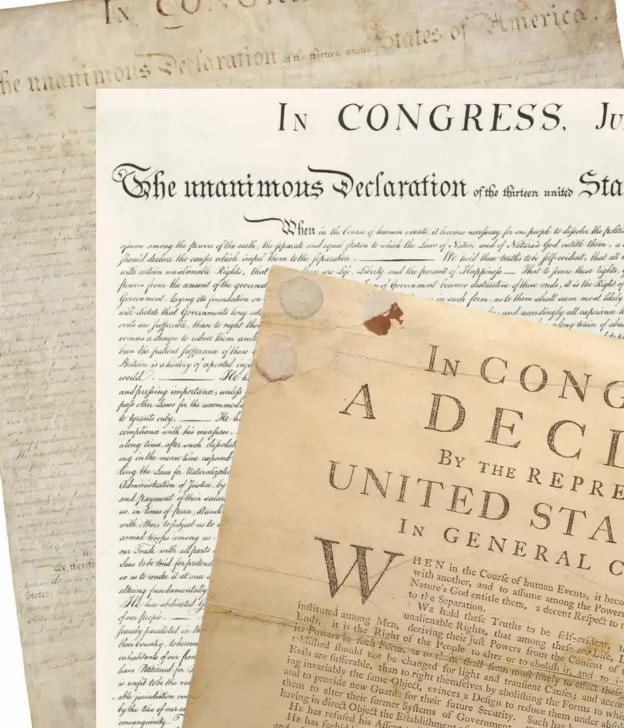
In a more restrained tone, the second paragraph of the  Declaration of Independence asserts the same principle. Governments, it proclaims, derive “their just powers from the consent of the governed.” Absent consent, a government is unjust and so revolution against it justified. By contrast, consent implies obligation. If I have consented to a government, then I must obey.

This deceptively simple argument begs various questions, particularly when, as today, ordinary citizens face a powerful state and have relatively few opportunities to influence its actions. Just when do I get the opportunity to consent to the powers of government? What counts as my having consented? Am I obliged to obey the government even if I disagree with some or most of what it does?

Political theorists have spilled much ink on these questions. As far back as John Locke’s Second Treatise of Government we find a distinction between express consent—the unambiguous verbal or written commitment to obey—and tacit consent. Locke concludes that “barely travelling freely on the Highway” of a commonwealth obliges one to obey its government, even if “he has made no Expressions of [consent] at all.” More recently, theorists have explored the idea of “hypothetical” consent, which gauges the justice of governmental powers by whether or not a hypothetically informed and rational citizen would consent to them.

We can get a sense of why all this theorizing matters by returning to the Declaration. As he spells out the “history of repeated injuries and usurpations” committed by the King of England, Jefferson draws a contrast between just government based on consent and despotic rule based on the “assent” of the monarch. George III, Jefferson writes, “has refused his Assent to Laws, the most wholesome and necessary for the public good;” and “he has forbidden his Governors to pass laws … till his Assent should be obtained.”

Parsing the difference between “consent” and “assent” might seem a diverting parlor game for college professors. But on that difference hangs Jefferson’s call for revolution. Consent suggests giving or allowing; it is a matter of granting permission. Assent involves agreement. Jefferson thus contrasts citizens allowing or permitting the operation of a just government that protects their rights with a monarch who demands that no law is law if it does not meet with his personal approval. Consent is a matter for free and equal human beings; King George’s emphasis on his own assent has rendered the colonists—as Jefferson puts it elsewhere in the Declaration —“dependent on his Will alone.”

In Common Sense, Paine imagines what the original moment of consent looked like. FreeFINAL Spring 2011 Newsletter 3 24_PrintersSpreadsProof (5) and equal people, he writes, came to appreciate “the convenience of their consenting to leave the legislative part to be managed by a select number chosen from the whole body, who are supposed to have the same concerns at stake which those have who appointed them, and who will act in the same manner as the whole body would act were they present.”

Consent, from this perspective, is not a simple matter of the government doing what I want it to do. The decisions of Paine’s representative body will not meet the approval of every citizen, even if the representatives “act in the same manner as the whole body would act were they present.” Indeed, were the whole body  of citizens present, common sense and everyday experience suggest that disagreement would be present, too. Consent instead, as Jefferson suggests, replaces assent. In place of elevating the agreement of any one citizen—king or commoner—consent might be understood as a matter of agreeing to disagree, while remaining bound together. The very idea of consent, we might say, makes dissent possible.

In the background, of course, stand the limits consent establishes. Only just powers can be derived from the consent of the governed. Where the exercise of power is consistently unjust, consent ends and dissent can legitimately give way to revolution. Locke perhaps best suggests the difficulty humans face in clearly drawing the fateful line between dissent and revolution: “the Appeal then,” he writes, “lies nowhere but to Heaven.”

Return to Top

Suggested Readings: Contemporary literature exploring America’s Founding and history

Washington, A Life, by Ron Chernow

In Washington; A Life celebrated biographer Ron Chernow provides a richly nuanced portrait of the father of our nation. With a breadth and depth matched by no other one-volume life of Washington, this crisply paced narrative carriers the reader through his troubled boyhood, his precocious feats in the French and Indian War, his creation of Mount Vernon, his heroic exploits with the Continental Army, his presiding over the Constitutional Convention, and his magnificent performance as America’s first president. (The Penguin Press, New York, 2010).

Ratification: The People Debate the Constitution, 1787-1788, by Pauline Maier

Pauline Maier’s Ratification; The People Debate the Constitution, 1787-1788, could not be more timely. It is the first comprehensive account of the debates in the 13 states over adoption of the Constitution. Others have written about specific aspects of the ratification struggle—about the arguments of one side or the other, or about the debate in a particular state—but remarkably, until now, no historian had written a full-length account of the politics, personalities, arguments, and outcomes between Sept. 17, 1787, when the Constitutional Convention completed its work, and May 29, 1790, when the last of the original states, Rhode Island, ratified the document.”

Michael W. McConnell

The Wall Street Journal, October 23, 2010

(Maier is a professor of American history at M.I.T.)

The Relentless Revolution: a History of Capitalism, by Joyce Appleby

The unlikely development of a potent historical force, told with grace, insight, and authority by one of our best historians. With its deep roots and global scope, the capitalist system provides the framework for our lives. It is a framework of constant change, sometimes measured and predictable, sometimes drastic and out of control. Yet what is now ubiquitous was not always so. Capitalism took shape centuries ago, starting with a handful of isolated changes in farming, trade, and manufacturing, clustered in early-modern England. Astute observers began to notice these changes and consider their effects.

Those in power began to harness these new practices to the state, enhancing both. A system generating wealth, power, and new ideas arose to reshape societies in a constant surge of change. The centuries-long history of capitalism is rich and eventful. Approaching capitalism as a culture, as important for its ideas and values as for its inventions and systems, Joyce Appleby gives us a fascinating introduction to this most potent creation of mankind from its origins to now.

Dr. Appleby was a featured speaker at the JMC Summer Institute in Chicago in 2010.

Return to Top

Jefferson’s Moral Philosophy Topic of UH Program

The Phronesis program at the University of Houston hosted a colloquium on “Jefferson’s Moral Philosophy” on February 18. The colloquium was led by Professor Michael Zuckert of the University of Notre Dame, who is serving as the 2010-2011 Ross M. Lence Master Teacher in Resident at the University of Houston’s Honor College.

Every year the Lence Master Teacher Residency Program invites a distinguished teacher to the Honors College for a week. The master engages with students, faculty, alumni, and friends of the Honors College by delivering lectures in Honors College courses, leading workshops on key texts in the Western intellectual tradition, and by attending various informal social engagements.

In addition to the Phronesis colloquium, Zuckert delivered a public lecture on Shakespeare’s The Tempest. In the evening, as part of the Ross M. Lence Master Teacher Residency Dinner, Zuckert gave a lecture entitled “Slavery at the Constitutional Convention.”

Return to Top

Exploring the JMC Web Site

The JMC Web site (www.jackmillercenter.org) offers a host of services and information that those interested in the teaching of America’s Founding Principles and history will find useful. Available information includes academic news, educational and informational videos, essays, higher education resources, event calendars, jobs in higher education, recommended books and donor resources.

JMC Videos

The JMC Web site acts as a repository for the ever expanding library of JMC Multimedia Productions. Currently, they are streamed directly to the Jack Miller Center Web site via YouTube. They may be accessed by going to the main Jack Miller Center Web site and clicking on the JMC Videos link under the “Educational Resources” header.

The JMC Videos page contains excerpts from the JMC informational DVD, divided into individual segments dedicated to certain parts of the JMC’s mission, as well as video interviews with prominent Americans such as Professors Gordon Wood, James Ceaser, Allen Guelzo, Judge Marjorie Rendell, Michael Barone and William Kristol.

JMC Book Store

The Jack Miller Center book store, found on the home page, contains recommended reading for individuals interested in the American Founding and works published by JMC partner scholars. A portion of all proceeds from sales goes directly towards funding the efforts of the Jack Miller Center. Additionally, a portion of all additional sales from Amazon.com benefit the JMC as long as Amazon.com is reached through links in the JMC Book Store.

Featured Program and Featured Professor

Periodically the Jack Miller Center profiles featured professors and programs that are part of the JMC network. The profiles of these programs and individuals can be found at the bottom of the home page.

JMC News

A primary function of the Jack Miller Center’s Web site is to be the source of the most up to date information regarding the JMC’s activities. The most recent news stories can be found on the home page of the Web site, and the archives are fully searchable using the search bar on the home page. Hovering the mouse cursor over the News header on the home page brings down a list where individuals may select a news stories with information relevant to the particular subject they are seeking.

Return to Top

Cullen and Peart Join JMC Academic Council

Professor Daniel Cullen and Dean Sandra Peart have accepted an invitation to join the JMC Academic Advisory Council. An associate professor of political science at Rhodes College, Professor Cullen teaches a wide range of courses in the history of political philosophy and Rhodes’ core humanities program. He is also the Director of the Project for the Study of Liberal Democracy at Rhodes, which promotes the study of American Constitutionalism and its philosophic sources.

Sandra Peart is Dean of the Jepson School of Leadership Studies at the University of Richmond. A distinguished scholar and former president of the History of Economics Society, Peart specializes in the history of economic thought and political economy. She was the featured speaker at the JMC’s annual National Summit on Higher Education last November in Philadelphia.

Return to Top

Dr. Bruce Cole on the Importance of Learning About America’s Founding Principles

FINAL Spring 2011 Newsletter 3 24_PrintersSpreadsProof (2) Dr. Cole is the president of the American Revolution Center      and the former chairman of the National Endowment for the  Humanities. A leading advocate for education in American  history, Dr. Cole is a member of the JMC’s board of directors.

JMC: Why is it important for students to learn about the Founding and about America’s heritage?

COLE: I think it’s very important. There is a growing  momentum to figure out who we are and where we’ve come  from, so we can know where to go. Millions of Americans are  buying books by renowned historians like David McCullough, Gordon Wood, Joseph Ellis, and Walter Isaacson, to name just a few, to learn about the American Revolution and the Founding. We’re always thinking about what would Washington do, what would Jefferson do, what’s Hamilton’s continuing influence what does the Declaration mean, what does the Constitution say? We always go back to our roots because we have a creed, the Declaration of Independence; we have a blueprint for this country, the Constitution. So those documents are incredibly important and they have been a kind of North Star for Americans since the beginning of the republic.

JMC: Are students getting the education they need to have a good understanding of our nation’s history?

COLE: Surveys and polls have shown that students really aren’t getting the kind of history education that they deserve. I could cite these in detail, but just let me give you a couple of examples. The Nation’s Report Card, a report by the Department of Education shows that over half percent of twelfth-graders score below basic in American history. And that’s worse than any other subjects, including math and science. That’s pretty astounding. And things aren’t much better at the college level. Tests have shown that college seniors don’t know much about history, and that many of them know less about history than they did when they entered as freshman. And so it seems, in some strange way that the longer you stay in school, the less you know about history.

JMC: Some studies show that many history teachers are not adequately prepared to effectively teach American history. Why?

COLE: There are many reasons for this. One of them is that our teachers – and now I’m talking about K through 12 – aren’t really getting the kind of history education they deserve. Education schools are producing lots of good people, but people who know a lot about educational psychology and lesson plan making, but not about subject matter, including history. History teachers at the K through 12 level have the fewest number of hours, the fewest number of minors, and the fewest number of majors of any other teachers, except probably those who teach physics. So you can’t teach what you don’t know. American history is not required in many colleges and universities, so you can graduate without taking a single course in American history. Our schools really are not preparing students to adequately understand this really critical point about who we are.

JMC: What do you say to those who argue that strengthening education in America’s Founding Principles should be focused on the high school level, not the college level? What are your thoughts about the Miller Center’s position that education in America’s Founding Principles should be part of the critical mission of colleges and universities?

COLE: I applaud the Jack Miller Center. I think you are doing pioneering work in trying to help young professors who are committed to a career in the classroom teaching America’s Founding Principles. I don’t think there’s anything more important than that. Years ago that’s what schools were about – to prepare citizens to take up their rights and their responsibilities. What’s happening in the colleges and universities today is students are not required to take any American history, and the other problem is that the field of American history is now divided up into so many specialties and sub-specialties, and sub-subspecialties, that in many cases, students aren’t getting a broad view of what American history is. When students graduate high school they don’t know very much history. And then, in college, they are not getting it at all, or they need a lot of remediation. So I think there’s a lot of work to be done in both K through 12, and at the college level. This is where history departments in colleges and universities can help K through 12 by educating future teachers in subject matter knowledge. So, yes, I think it’s absolutely not only a necessity, but a responsibility of colleges and universities to instruct young people in our nation’s founding and in their rights and their responsibilities.

JMC: How did you get involved in the American Revolution Center?

COLE: I think it was a sort of natural segue as improving knowledge of American history was a primary focus for me when I was chairman of the National Endowment for the Humanities. I have been interested in American history from very early on. I mean, my first interest in that came – and I’ve told this story a million times – when I was a kid and growing up in Cleveland, and somehow got down to the Western Reserve Historical Society and started looking at these artifacts. You know, things that people had held, and somehow that sparked an interest. So I have had a real interest in American history for a long, long time. I remember when I was thinking about this job I didn’t quite believe that when they said this is the first museum – national museum – dedicated to the American Revolution. And I remember Googling and finding out, hey, that’s really true. That is really pretty astounding – that there is no museum. There are lots of parts of the American Revolution, really important parts of the American Revolution at places like Mount Vernon, Mount Montpelier, Bunker Hill – but we want to tell the whole story of the Revolution. So we are building the first museum dedicated to the American Revolution on Third and Chestnut Street in the “Cradle of Liberty,” Center City Philadelphia. Our location is really perfect and we’re looking forward to opening our museum there. I’m dedicated to this because I believe that we can help Americans achieve a better understanding of the ideas and ideals, and the principles, which formed this country. I hope we can work with the Miller Center to have a very robust educational program.

Return to Top

The Little Engine that Could

By Jack Miller

In November 2004, I hosted 50 professors from around the country in Chicago for a two day discussion on how we could re-introduce the teaching of America’s Founding Principles and history back onto college campuses. There was a lot of pessimism in the room about whether it was possible to do. “A lot of my colleagues on campus won’t let it happen,” was a common theme. “We can’t get the money to pay for such programs,” said others. “We don’t have the time to develop such programs,” and “It’s hard to deal with the administration,” said others. Gloom and doom filled the room.

Fast forward to February 24, 2011, just 7 years later, at our JMC board of directors meeting. The room was brimming with energy and optimism was high about what we had accomplished and even higher for what the future held. What made the difference?

Well, we carefully analyzed the input we received from the professors and then crafted a mission statement and a strategy to make it happen. After funding a start-up phase that same year and spending three years proving we could make it happen, I then, in 2007, pledged an additional $10 million over the next five years. We strengthened our team and have great results.

With the financial support of many donors, we developed outstanding summer institutes so we can bring together and mentor postdoctoral fellows and young professors. We help prepare them for a challenging job market. Today we have over 400 Miller Fellows teaching on 171 campuses. In addition, we are supporting academic centers and programs on 44 campuses. All of this has already provided tens of thousands of young people new opportunities to learn about our wonderful country and the principles that make it so. We even have an academy for high school teachers to help them do a better job in this area.

But we are nowhere near the top yet and that little engine (not so little now) keeps chugging away. The opportunities are almost endless. Our faculty partners are moving ahead with expansion plans and we are being approached on a regular basis by professors who want our help to start new programs of their own. As with all such endeavors, the only thing needed is the money to take advantage of those opportunities.

This work is essential as several of our Founding Fathers, as well as many other prominent Americans over the years, said that an educated citizenry is the foundation of our republic. Perhaps Thomas Jefferson said it best, “If a nation expects to be ignorant and free, in a state of civilization, it expects what never was and never will be.”

If you are interested in supporting programs at your local universities or your alma-mater, please contact Rear Admiral (USN Ret.) Mike Ratliff, president of the JMC at 484-436-2065. With your help we can educate more and more of our young people on the principles that have kept us free for almost 250 years.”

Return to Top

Semester Symposium on U.S. Civil War: American University

Wednesday, January 12th, 2011

The Washington DC Political Theory Colloquium
Spring ’11:

Friday, January 28th LOCATION:        Mary Graydon 200

James Read, “John C. Calhoun’s Political Theory and Its Contemporary Echoes”

James H. Read is Professor of Political Science and Joseph P. Farry Professor of Public Policy and Civic Engagement at the College of St. Benedict and St. John’s University of Minnesota. He is the author of Majority Rule versus Consensus: The Political Thought of John C. Calhoun (2009), among other books and articles.

Friday, February 25th

Diana Schaub, “Learning to Love Lincoln: Frederick Douglass’s Journey from Grievance to Gratitude”

Diana J. Schaub is Professor of Political Science at Loyola University Maryland and a member of the Hoover Institution’s Jill and Boyd Smith Task Force on the Virtues of a Free Society. She is the author of Erotic Liberalism: Women and Revolution in Montesquieu’s Persian Letters (1995), along with a number of book chapters and articles in the fields of political philosophy and American political thought, and a co-editor (with Amy and Leon Kass) of What So Proudly We Hail: The American Soul in Story, Speech, and Song (forthcoming, 2011).

Tuesday, March 15th

William B. Allen, “What Constitution Have I? Harriet Beecher Stowe and the Moral Imperative of Constitutionalism”

William B. Allen is Emeritus Professor of Political Philosophy in the Department of Political Science and Emeritus Dean, James Madison College, at Michigan State University. He is the author of Re-Thinking Uncle Tom: The Political Philosophy of Harriet Beecher Stowe (2009).

Thursday, April 7th

Michael Zuckert, “Completing the Constitution: the Post Civil War Amendments”

Michael Zuckert is Nancy R. Dreux Professor of Political Science at University of Notre Dame. He is the author of Launching Liberalism: On Lockean Political Philosophy (2002) as well as many other books and articles on early modern political philosophy, American constitutional history and the theory of liberty.

Friday, April 22nd

Hugh Liebert, “Lincoln’s Political Religion”

Hugh Liebert is the John Marshall Visiting Research Fellow at the University of Richmond and will soon be joining the Department of Social Sciences in the United States Military Academy as an assistant professor. He is co-editing a volume on executive power, to which he has contributed a chapter on the development of executive power in the Roman Republic, and is completing a book project on Plutarch’s political philosophy titled Plutarch’s Political Thought: City and Empire in the Parallel Lives.

Times and Location: Unless otherwise noted, all talks are held on the campus of American University in the Lounge (Room 105) of the East Quad Building (also known as the Old SIS Building), from 5:30-7:00pm.

Everyone is welcome!

Melancton Smith Unmasked: The Anti-Federalist Writings

Sunday, October 24th, 2010
The Anti-Federalist Writings of the Melancton Smith Circle, edited by Michael
P. Zuckert and Derek A. Webb. Indianapolis: Liberty Fund, Inc., 2009, 447 pp.,
$29.00 cloth, $14.50 paperback.
Book Review (excerpted from publius.oxfordjournals.org)
Reviewed by Jonathan L. Silver
Georgetown University
In The Anti-Federalist Writings of the Melancton Smith Circle, editors Michael P. Zuckert and Derek A. Webb collect some of the most sophisticated and theoretically rich essays, speeches, letters, notes, and pamphlets by the Constitution’s opponents during the debate over its ratification. The volume reproduces in full everything the editors could find authored by Melancton Smith, including his speeches at the New York Ratifying Convention in 1788, as well as the Letters from the Federal Farmer and the Essays of Brutus. The contents of this volume are narrower than the two most popular competing compendiums of Anti-Federalist writing, both Murray Dry’s abridgment of Herbert J. Storing’s The Complete Anti-Federalist (Chicago: The University of Chicago Press, 1985) and Ralph Ketcham’s edition of The Anti-Federalist Papers and the Constitutional Convention Debates (New York: Signet Classic, 2003). Excluding Centinel, A (Maryland) Farmer, Agrippa, the Impartial Examiner, Patrick Henry and others allow the editors to present more focused and coherent critical assessment of the proposed Constitution, in turn making it easier for students and scholars of these debates to specify their arguments with greater precision.
Zuckert and Webb have produced a volume that deserves a wide and thankful readership. While historians will find their carefully documented claims about a Smith circle of great interest, it is really political scientists who should consider the arguments of the Smith circle. Images of the American past and particularly of the founding dominate American political rhetoric. Nearly all serious public policy proposals are presented in terms of fulfilling the original ideals of the nation’s founding. Visionaries on the political left and the political right both seek to show that they are the true heirs of the same founding. A real science of politics must ascertain the wisdom of that founding, and competing claims to its mantel. In the service of that science, Zuckert and Webb help students and scholars of American politics rediscover that the framers do not pronounce their wisdom in one coherent and seamless voice. The founding of the United States took the unique form of a political debate, and arguments on multiple sides of that debate are responsible for the nation that grew out of it. As this volume so clearly demonstrates, the most eloquent arguments for the Bill of Rights, and the clearest recognitions of American political institutions’ dependency on a vibrant and
robust civic culture, were often advanced by the same framers who harbored the most
serious misgivings about the Constitution.

The Anti-Federalist Writings of the Melancton Smith Circle, edited by Michael

P. Zuckert and Derek A. Webb. Indianapolis: Liberty Fund, Inc., 2009, 447 pp.,

$29.00 cloth, $14.50 paperback.

Book Review (excerpted from publius.oxfordjournals.org)

Reviewed by Jonathan L. Silver

Georgetown University

In The Anti-Federalist Writings of the Melancton Smith Circle, editors Michael P. Zuckert and Derek A. Webb collect some of the most sophisticated and theoretically rich essays, speeches, letters, notes, and pamphlets by the Constitution’s opponents during the debate over its ratification. The volume reproduces in full everything the editors could find authored by Melancton Smith, including his speeches at the New York Ratifying Convention in 1788, as well as the Letters from the Federal Farmer and the Essays of Brutus. The contents of this volume are narrower than the two most popular competing compendiums of Anti-Federalist writing, both Murray Dry’s abridgment of Herbert J. Storing’s The Complete Anti-Federalist (Chicago: The University of Chicago Press, 1985) and Ralph Ketcham’s edition of The Anti-Federalist Papers and the Constitutional Convention Debates (New York: Signet Classic, 2003). Excluding Centinel, A (Maryland) Farmer, Agrippa, the Impartial Examiner, Patrick Henry and others allow the editors to present more focused and coherent critical assessment of the proposed Constitution, in turn making it easier for students and scholars of these debates to specify their arguments with greater precision.

Zuckert and Webb have produced a volume that deserves a wide and thankful readership. While historians will find their carefully documented claims about a Smith circle of great interest, it is really political scientists who should consider the arguments of the Smith circle. Images of the American past and particularly of the founding dominate American political rhetoric. Nearly all serious public policy proposals are presented in terms of fulfilling the original ideals of the nation’s founding. Visionaries on the political left and the political right both seek to show that they are the true heirs of the same founding. A real science of politics must ascertain the wisdom of that founding, and competing claims to its mantel. In the service of that science, Zuckert and Webb help students and scholars of American politics rediscover that the framers do not pronounce their wisdom in one coherent and seamless voice. The founding of the United States took the unique form of a political debate, and arguments on multiple sides of that debate are responsible for the nation that grew out of it. As this volume so clearly demonstrates, the most eloquent arguments for the Bill of Rights, and the clearest recognitions of American political institutions’ dependency on a vibrant and robust civic culture, were often advanced by the same framers who harbored the most serious misgivings about the Constitution.

|Buy it Today|

Enhanced by Zemanta

Michael Zuckert Receives ASFI Award

Thursday, May 6th, 2010

• Lisa Walenceus

From University of Notre Dame: Faculty News, General News, and Research

Michael Zuckert, Nancy Reeves Dreux Professor of Political Science and former chair of Notre Dame’s Department of Political Science, will receive the Association for the Study of Free Institutions (ASFI) Award for Distinguished Scholarship on the Nature of a Free Society at the association’s annual conference in May 2010 at Princeton University.

According to Carson Holloway, executive director of ASFI, “Michael Zuckert—with his outstanding work on the political thought of John Locke, on the American founding, and on the meaning of the Fourteenth Amendment, among many other topics—is a worthy recipient of this award.”

ASFI inaugurated the annual honor not just to recognize a single work of scholarship but to recognize a scholar whose entire body of work is characterized by intellectual excellence and attention to the foundations of a free society, its character, or the challenges that it faces.

“Michael Zuckert is one of America’s most eminent scholars of American political thought and constitutional studies,” Michael Desch, current department chair, notes. “In addition, he has been a real leader here at Notre Dame in building one of the nation’s preeminent programs in that area, at the undergraduate, graduate, and post-doctoral levels. He richly deserves this award both in recognition of his own scholarship on free institutions and also for what he has contributed to building a community of younger citizens and scholars who’ll follow in his footsteps.”

In addition to accepting the award, Zuckert will deliver the AFSI conference’s keynote address, titled “Natural Law, Natural Rights, and the American Republic.”

“Of course, I consider it a great honor to be given the AFSI award,” Zuckert says. “I have devoted my scholarly life to trying to understand better the nature of human freedom and a free society, and it pleases me very much that my work has struck some as contributing to that task in a positive way.”

Co-sponsored by the University of Nebraska at Omaha, the Bouton Law Lecture Fund, and Princeton’s James Madison Program in American Ideals and Institutions, the 2010 AFSI conference will feature scholars from the social sciences and humanities speaking on the influence of natural law thinking on the American founders, the role of natural law and natural rights in post-founding American history and politics, the place of natural law in American jurisprudence, and the compatibility of the doctrine of natural rights with prudence and community.

Zuckert’s scholarship focuses on political philosophy, American constitutional law and theory, and American political thought. Author of Natural Rights and the New Republicanism, The Natural Rights Republic, and Launching Liberalism: On Lockean Political Philosophy, he most recently co-edited The Anti-Federalist Writings of the Melancton Smith Circle with Derek Webb in 2009. He co-authored and co-produced the public radio series Mr. Adams and Mr. Jefferson: A Nine Part Drama for the Radio and was senior scholar for Liberty!, a six-hour public television series on the American Revolution. He also was lead scholar for two other PBS series, one on Benjamin Franklin and another on Alexander Hamilton.

Reblog this post [with Zemanta]

Miller Center Network Publications

Thursday, February 11th, 2010

The Jack Miller Center wants to congratulate the members of our JMC network who have published a book length manuscript in the last calendar year. Few accomplishments are as meaningful and lasting for authors, and those who read them.

The list also is a demonstration of the broad intellectual interests of our network. Although many directly address America’s Founding and History, the list includes subjects and authors that compose the intellectual, historical, and political resources the American Founders drew upon as well as current events that are of interest to all of us.

Nathan Busch, Combating Weapons of Mass Destruction: The Future of Non-Proliferation Policy, co-edited with Daniel H. Joyner (University of George Press, 2009)

Ross Corbett, The Lockean Commonwealth (SUNY, 2009)

Donald Critchlow, ed., Debating Conservatism (Rowman and Littlefield, 2009),  Politics and Hollywood (Routledge, 2009)

John Dinan, paperback edition of The American State Constitutional Tradition

Jonathan Dunn, From Schoolhouse to Courthouse: The Judiciary’s Role in American Education, co-edited with Martin West (Brookings Institution Press, 2009)

Robert Faulkner and Susan Shell, co-editors of American at Risk: Threats to Liberal Self-Government in an Age of Uncertainty (University of Michigan Press, 2009)

Michael Gillespie, paperback edition of The Theological Origins of Modernity

Allen Guelzo, Lincoln (Oxford University Press, 2009), Abraham Lincoln as a Man of Ideas (Southern Illinois University Press, 2009)

William Hay, Lives of Victorian Political Figures, Part IV (William Bagehot) (Pickering and Chatto Publishers, 2009)

Louie Herbert, More than Kings and Less than Men: Tocqueville on the Promise and Perils of Democratic Individualism (Lexington Books, 2009)

Steve Kautz, The Supreme Court and the Idea of Constitutionalism, co-edited with Arthur Melzer, Jerry Weinberger, Richard Zinman (Penn Press, 2009)

Christopher Kelly, Rousseau on Women, Love, and Family, co-edited with Eve Grace (University Press of New England, 2009)

Harvey Klehr, co-author of Spies: The Rise and Fall of the KGB in America (Yale University Press, 2009), The Communist Experience in America (Transaction Publishers, 2009)

Benjamin Kleinerman, The Discretionary President: The Promise and Peril of Executive Power (2009)

Robert Koons, The Waning of Materialism: new Essays on the Mind/Body Problem, co-edited with George Bealer (Oxford University Press, 2009)

Ralph Lerner, Playing the Fool: Subversive Laughter in Troubled Times (University of Chicago Press, 2009)

Paul Rahe, Montesquieu and the Logic of Liberty: War, Religion, Commerce, Climate, Terrain, Technology, Uneasiness of Mind, the Spirit of Political Vigilance, and the Foundations of the Modern Republic (Yale University Press, 2009), Soft Despotism, Democracy’s Drift: Montesquieu, Rousseau, Tocqueville, and the Modern Prospect (Yale University Press, 2009)

Eric Sands, American Public Philosophy and the Mystery of Lincolnism (University of Missouri Press, 2009)

Brian Schoen, Fragile Fabric of Union: Cotton, Federal Politics, and the Global Origins of the Civil War (Johns Hopkins Press, 2009)

Colleen Sheehan, James Madison and the Spirit of Republican Self-Government (Cambridge University Press, 2009)

Susan Shell, Kant and the Limits of Autonomy (Harvard University Press, 2009)

Steven Smith, The Cambridge Companion to Leo Strauss (2009)

Barry Strauss, The Spartacus War (Simon & Schuster, 2009)

Jeffrey K. Tulis, The Constitutional Presidency, co-edited with Joseph M. Bessette (Johns Hopkins University Press, 2009)

Gordon Wood, Empire of Liberty: A History of the Early Republic, 1789-1815 (Oxford, 2009)

Michael Zuckert, The Anti-Federalist Writings of the Melancton Smith Circle, co-edited with Derek Webb (Liberty Fund, 2009).

Reblog this post [with Zemanta]

Michael P. Zuckert, Nancy Reeves Dreux Professor of Political Science

Monday, September 28th, 2009

University of Notre Dame

The Tocqueville Program and the Constitutional Studies project in the Political Science Department at the University of Notre Dame are important efforts, partially funded by the Jack Miller Center and its partner foundations, to increase the study of American Constitutional History and civic life. The faculty partner at the heart of this effort at Notre Dame is Michael P. Zuckert (B.A., Cornell University; Ph.D, University of Chicago, 1974).

Professor Zuckert works widely in the field of political philosophy, American constitutional law and theory, and American political thought. He has published Natural Rights and the New Republicanism and The Natural Rights Republic, which was named an outstanding book for 1997 by Choice magazine. In addition, Zuckert has published articles on a variety of topics, including George Orwell, Plato’s “Apology,” Shakespeare, and contemporary liberal theory. His most recent book is Launching Liberalism: On Lockean Political Philosophy. He is currently completing a book entitled Completing the Constitution: The Post-Civil War Amendments, is co-authoring a book on Machiavelli and Shakespeare, and has been commissioned to write the volume on John Rawls for a new series on Twentieth Century Political Philosophy . He co-authored and co-produced the public radio series Mr. Adams and Mr. Jefferson: A Nine Part Drama for the Radio and was senior scholar for Liberty!, a six hour public television series on the American Revolution. He has received grants from NEH, the Woodrow Wilson Center, Earhart Foundation and NSF, and has taught at Carleton College, Cornell University, Claremont Men’s College, Fordham University, the University of Minnesota, and the University of Michigan at Ann Arbor.

Michael Zuckert

Michael Zuckert

Professor Zuckert has a reputation as one of the best classroom teachers in the United States for both graduate and undergraduate students. He also participates as a faculty member at our Jack Miller Summer Institutes and has played a leading role in the consortium of Chicago area schools involved in the JMC Chicago Initiative.

Reblog this post [with Zemanta]