A Jack Miller Center Pathway to the Founding Essay

Hume
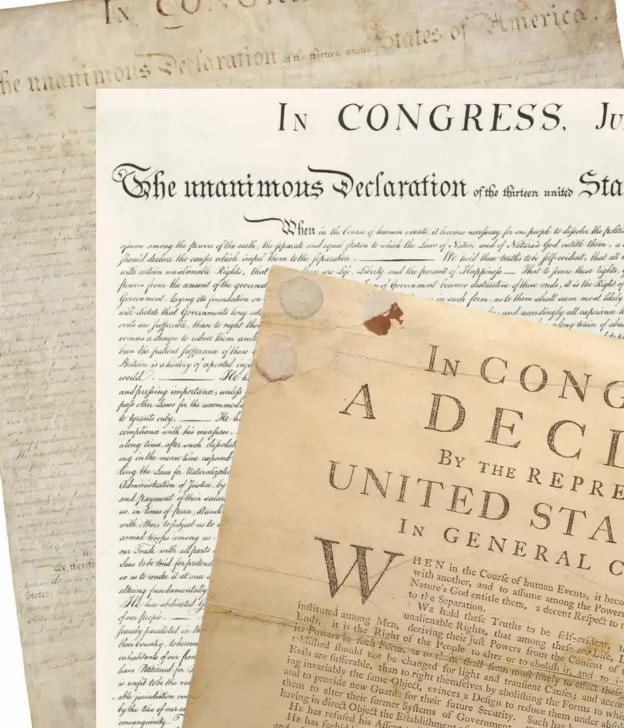
David Hume (b. 1711) died the year Jefferson penned the Declaration of Independence. While he may have rolled over in his grave had he seen the theorizing of the American Founders, he was more than a little sympathetic with the goals of American political practice.
On the one hand, in his essays “Of Civil Liberty,” “Of the Original Contract,” “Of Passive Obedience,” and “Of the Rise and Progress of the Arts and Sciences,” Hume opposed the rise of a rights-based, social contract thinking characteristic of Locke and the Declaration. Locke’s Second Treatise, Hume writes, was a book “most despicable, both for style and matter.” Hume’s worry was that “parties from principle, especially abstract speculative principle” would give rise to a dangerous factionalism. Because he criticized such speculative principles and the natural rights foundation of the American republic, the most revolutionary and Whiggish Americans branded Hume a Tory. Writing of Hume’s magisterial History of England, Jefferson thought Hume had “undermined the free principles of the English Constitution”; Jefferson considered Hume to be a “traitor to his fellow man.”
On the other hand, in his essays such as “Of Commerce” and “Of Refinement in the Arts,” Hume looked forward to the ascension of a more humane, stable politics, and he thought that the advancement of the modern commercial enterprise would help bring such a politics about. He discerned the importance of such political structures as the separation of powers, the checks and balances, and the extended commercial republic as a means of mitigating the effects of faction and promoting political moderation. As Americans focused less on the origin of political power and the establishment of popular government and more on the proper exercise of power and the prevention of democratic factionalism, they found Hume an invaluable guide. Hume writes, “there is compass and room enough” in large polities “to refine democracy through representation.” A society “dispersed in small bodies” is “more susceptible both of reason and order; the force of popular currents and tides is, in a great measure, broken; and the public interest may be pursued with some method and constancy.” These links between Hume and the American Founders are pursued most persistently in the pioneering work of Douglas Adair, whose Fame and Founding remains the locus classicus of Hume’s influence.
Hume appears hostile to the Declaration, yet a friend of the Constitution. The question of Hume scholarship concerns how these political aspects of Hume’s thought fit in with his philosophic reflections. To this day, many have argued that a “philosophical melancholy” led Hume to quite philosophical studies for the world of political essays and history. In Thomas Reid’s Inquiry into the Human Mind (1764), Hume emerges as a skeptic who destroyed the Enlighenment faith in our ability to apprehend the external world and our ability to guide political practice through reason. Reid sought to replace Hume’s radical skepticism with a philosophy of common sense.
While Reid’s views were echoed through the years in philosophers such as Immanuel Kant, John Stuart Mill, and T.H Green, during the Twentieth Century scholars have emphasized how Hume himself aligns with a “philosophy of common life” through what Hume himself calls a mitigated skepticism, and this eventually led to the view that Hume’s skepticism prepares the way for his embrace of political moderation. The “common sense” Hume emerged in a two-step process. First, Norman Kemp Smith’s Philosophy of David Hume (1941), still the classic study of David Hume, initiated this re-evaluation of Hume’s thought. Kemp Smith argued that Hume’s skepticism was in the service of what he called naturalism—reason must be subordinated to feelings and instincts if we are to explain the way human beings perceive the world. Kemp Smith did not detect a link between Hume’s philosophy and his politics.
Second and most decisively, scholars such as Donald Livingston (Hume’s Philosophy of Common Life (1984) and Philosophical Melancholy and Delirium: Hume’s Pathology of Philosophy (1998)), Nicholas Capaldi (Hume’s Place in Moral Philosophy (1989)) and John W. Danford (David Hume and the Problem of Reason (1990)), painted a complete picture of Hume, uniting his philosophic works with his political disposition. The position of these books, in one way or another, is that Hume’s skepticism served as a preparatory ground for philosophical and political moderation. He used his skepticism to poke holes in doctrines such as the distinction between primary and secondary qualities or social contract theory in order to prepare people to understand that doctrines and principles do not best explain human life. Moreover, against Kemp Smith and his followers, this wave of Hume’s scholars show that reason can help to correct the mistakes of instinct and feeling. What emerges is a Hume whose skepticism is mitigated by feelings and instincts and whose naturalism is mitigated by reason. Given our complex set of equipment, we would do well not to expect perfection or certainty in politics or philosophy and this explains why Hume defended the institutions of political moderation in the modern world.
![Reblog this post [with Zemanta]](http://img.zemanta.com/reblog_e.png?x-id=61524ba7-f8be-4582-9959-947c3e911be5)