Teaching the Declaration Starts at the Archives
May 12, 2026
Every generation inherits the Declaration of Independence and its promises. The Declaration’s memorable phrases—“all men are created equal,” “unalienable rights,” “the pursuit of happiness,” and “consent of the governed”—permeate the American experience. But phrases alone cannot sustain the weight of a nation’s founding. To teach the Declaration meaningfully, to help students see it as both an anchor and a provocation, we need more than words. We need the records that give those words context, consequence, and demonstrable meaning. That is the charge of the National Archives— to protect, preserve, and share the stories that bring the Declaration to life.
During my tenure as Archivist of the United States, I saw firsthand how deeply Americans of all ages and backgrounds respond to the Declaration when they encounter it. The Rotunda of the National Archives, home to the Charters of Freedom, is a place of quiet awe. But what resonates with visitors is not faded ink behind protective glass. It is the realization that the Declaration ignited a revolution whose effects can be traced across millions of histories, from immigration records to military service files to patent petitions. Together, they document the complex and often byzantine progress the United States has made toward fulfilling the Declaration’s ideals.
The Declaration remains our starting point, but its significance is renewed each time we read it. As citizens, revisiting the text, reading it slowly and often, reminds us of our shared heritage and sharpens our ability to hold the government accountable to its first principles.
I regularly saw families and school groups reading the Declaration aloud—parents guiding children through the first paragraphs, teachers pointing to familiar lines with fresh meaning.
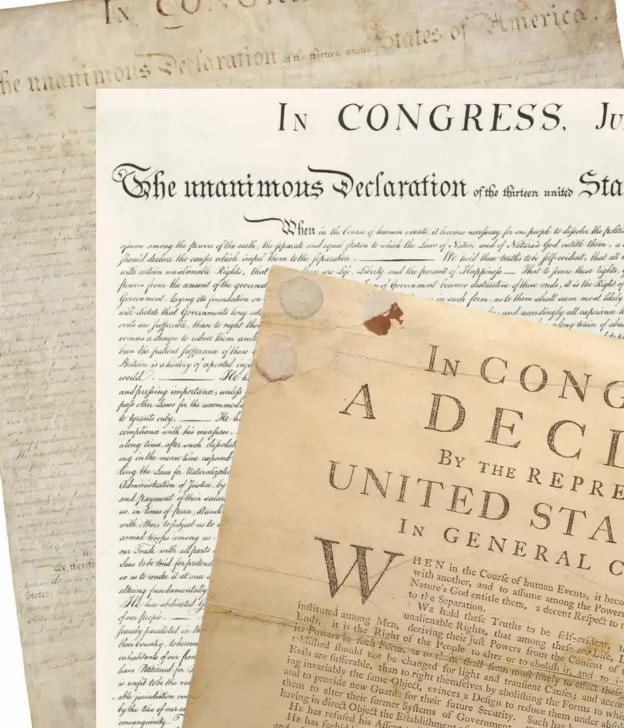
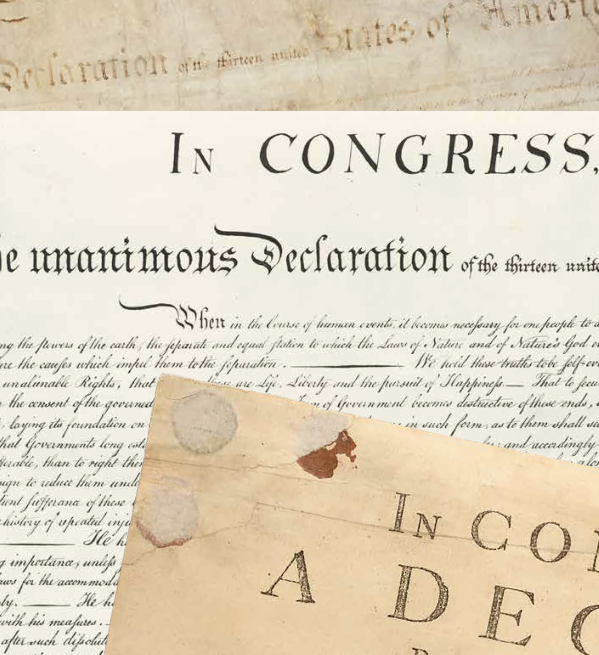
Early in my tenure as archivist, I grew concerned about the readability of the original Declaration on display. After years of exposure, the Declaration has now faded to the point of near illegibility. To remedy the situation, we created an enlarged facsimile of the 1823 “Stone Print” of the Declaration and placed it immediately outside the Rotunda for display. The accompanying label explained the reason for its presence and invited visitors to stop and read the text.
I visited the Declaration of Independence almost every day I worked inside the National Archives Building in Washington, D.C. After observing the hundreds of visitors from across the United States waiting in line patiently to view the founding documents, I often paused by the replica Stone Print. I regularly saw families and school groups reading the Declaration aloud—parents guiding children through the first paragraphs, teachers pointing to familiar lines with fresh meaning. Those moments reaffirmed my belief that Americans are eager to engage with history when given the opportunity.
Archives make that engagement possible. They enable educators to present the Declaration not as a relic but as a living argument—one invoked by abolitionists, suffragists, civil rights leaders, and countless others who have insisted the nation live up to its stated ideals. I often said that archives are where democracy keeps its receipts. They record not only what we aspired to in 1776, but what we chose, failed, attempted, or resisted in the years that followed. They reveal the distance between promise and practice and give us the tools to assess our progress honestly.
My time stewarding the nation’s records strengthened my conviction that archives are essential civic infrastructure.
Teaching the Declaration in this way also cultivates habits of mind our democratic republic urgently needs in 2026: evaluating sources, distinguishing fact from ideology, and engaging in collective problem-solving. At a time when misinformation spreads faster than primary sources, these skills are foundational to citizenship.
My time stewarding the nation’s records strengthened my conviction that archives are essential civic infrastructure. They preserve the raw materials that allow each generation to rediscover the Declaration, interpret it anew, and ask what it demands of us now. The words of 1776 continue to inspire, but their durability depends on the routine work of preserving and sharing the documents that make those ideals tangible.
We teach the Declaration of Independence best when we teach it as part of a larger American story—one grounded in evidence, enriched by debate, and strengthened by the willingness to celebrate our achievements and confront our unfinished work. Archives make that possible. They keep the words that changed the world alive and relevant. Most importantly, they keep the republic accountable to its citizens.

About the Author
Colleen Shogan is the CEO of In Pursuit, a signature America250 project of More Perfect. She is also a Senior Fellow in Civics Education at Stand Together. She served as the 11th Archivist of the United States, and serves as a Jack Miller Center National Civics Council Member.