
America as Real and Beautiful
“America the Beautiful” is a patriotic song that celebrates our nation’s efforts to live up to the Declaration’s promises, writes Paul Carrese.
October 15, 2026
A central virtue in American civics is reflective patriotism, blending love of country with rational discourse about our ideals, and whether we’re living up to them. This disposition engenders hope about America, making us aware not just of our failings but also our great goodness. In my 2026 book Teaching America: Reflective Patriotism in Schools, College, and Culture, I cite Annette Gordon-Reed, a prominent historian of Thomas Jefferson’s relations with his slave Sally Hemings, as a model of civic hope. Gordon-Reed observes in her memoir about growing up in segregated Texas that looking back required “striking the right balance”—to write about a place she loves with a “clear-eyed assessment” of its “strengths and weaknesses.” Such love and balance includes the patriotism toward America shown even by those unjustly treated: “Almost from the very beginning of their time in North America, Blacks have shown their deep patriotic attachment to the country they helped to build;” evincing the paradox for slave descendants “of loving a place that was deeply oppressive to their ancestors.”
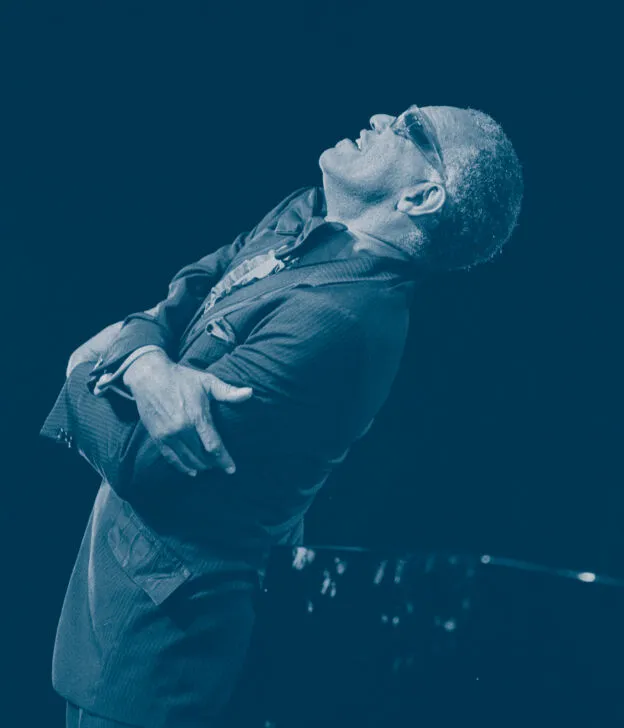
Another prominent descendent of slaves, pianist and singer Ray Charles, shows this balanced and hopeful view in the reflective patriotism infusing his rendition of “America the Beautiful.” He first recorded it in 1972 shortly before the bicentennial celebrations of 1976. We should feature it in this America 250 moment commemorating our founding era, now and for the next two decades.
Charles’s celebratory version was an outgrowth of the hopefulness-despite-injustice embodied in jazz, which I discuss in Teaching America as among America’s greatest achievements—blending liberty and order, soloist and group, tradition and innovation, and multiple civilizations and genres. Charles and his producer for the 1972 album A Message from the People, the jazz trumpeter turned music impresario Quincy Jones, chose to open with the third verse of the Katharine Lee Bates 1911 hymn-poem, to emphasize the beauty of “heroes proved / in liberating strife.” This celebrates the momentous civic reform in the Civil War, which for Union soldiers became a fight to end slavery.
If you haven’t heard Charles’s “America,” or not in a while, treat yourself to this great civic experience. The striking choice of opening emphasizes traditional American virtues of patriotic sacrifice and Christian mercy, made newly inspiring by Ray’s signature blend of gospel music, blues, rhythm & blues, and jazz—often termed soul music.
In giving thanks for Union soldiers in the original poem, Bates echoed Lincoln’s eulogy at Gettysburg for “the brave men . . . who struggled here,” already having “consecrated” the battlefield “far above our poor power to add or detract.” Brother Ray (as he entitled his 1978 autobiography) turns eulogy into civic hope by placing this theme ahead of the widely remembered first verse beginning “O beautiful for spacious skies / for amber waves of grain.”
Charles pulls together the spirit of religion and spirit of jazz to celebrate America, first through gratitude for those who secured the freedom we enjoy. Lincoln and Bates harmonized biblical religion and a political philosophy of liberty and equality to define and celebrate America. Decades later Charles, a black American from Georgia and descendent of slaves, insisted we first give thanks to the mostly white soldiers moved by “mercy” to fight and die for the freedom of black people.
O beautiful for heroes proved
In liberating strife,
Who more than self their country loved
And mercy more than life!
America! America!
May God thy gold refine,
Till all success be nobleness,
And every gain divine!
Brother Ray then sets up his second verse—Bates’s first—by improvising “when I was in school we used to sing it something like this—listen here!” Yet the spirit of jazz inspires other vocal and instrumental improvisations hardly heard in school until then: Declaring his own love for America, that “my God he done shed his Grace on thee,” and how we ought to thank God for doing so—with Charles modeling this last point in exultant shouts.
The blend of gratitude, humility, exuberance, and piety was so powerful and popular that it led to Charles regularly performing it for his final three decades (he died in 2004)—including at the White House, a 1984 presidential nominating convention, the World Series, and in Yankee Stadium after the 9/11 attacks.
The album A Message from the People also contains discontent, including the 1968 song Abraham, Martin, and John celebrating martyrs of social change—Lincoln, John F. Kennedy, Martin Luther King, Jr., and Robert Kennedy. Charles later described the album as both criticizing America and expressing love, partly for “the spirit of America” that allowed him to work hard and succeed despite his humble origins, blindness, and racism. He noted a “black magazine wrote that I was selling out,” to which he replies: “Ever since I started traveling round the world and seeing other places, I’ve been convinced that what we got—as rotten as part of it might be—is hipper than anything else I’ve noticed out there.” Quincy Jones, who produced and arranged for the singer Frank Sinatra in the 1960s, and would produce and arrange for Michael Jackson in the 1980s, held the same civic hope for America.
Ray Charles’s blend of hope, high standards, and sober appreciation for America is a model of reflective patriotism, and the kind of civic lesson American culture should offer.

About the Author
PAUL CARRESE is Director of the Center for American Civics and Professor in the School of Civic and Economic Thought and Leadership, Arizona State University, and Senior Fellow of the Jack Miller Center. In summer 2027 he will join the University of Virginia as a professor in its revitalized Program on Constitutionalism and Democracy.