
American Identity in Three Dimensions
October 15, 2026
In 1818, John Adams reflected on the meaning of the American Revolution. “The Revolution,” he wrote, “was effected before the war commenced. The Revolution was in the minds and hearts of the people . . . . This radical change in the principles, opinions, sentiments, and affections of the people, was the real American Revolution.”
At Citizen University, the organization I lead, our shorthand for Adams’s observation is that culture precedes structure. Before there can be any structural change in the body politic—from policy change to revolution—there must first be a shift in civic culture, a sea change in collective temper and norms. In the case of our Revolution, that shift—from subjects to citizens, from faith in a monarch to faith in each other—unfolded over several decades.
And what was true of those decades before 1776 has been true of the 250 years since. Our revolution, indeed our national purpose, has always been a matter of habit and culture. If it lives still, that is only because we continue to animate it in our everyday choices.
There are three dimensions to those choices: creed, conflict, and combination. America is an idea. America is an argument. And America is a hybrid. Each of these is a way to understand what being American calls us to do.
Let’s start with creed. You might think, as many Americans do today, that things are profoundly on the wrong track in the United States. That our government has been overreaching in ways that recall the Declaration’s bill of particulars against the king. That economic opportunity has been evaporating for two generations. That everyday life has become more inhumane. That there is rot at the foundation of our institutions.
You wouldn’t be wrong. Yet even the most disappointed and disillusioned among us still have something to cherish. In fact, the very source of our disappointment and disillusionment is the American creed itself.
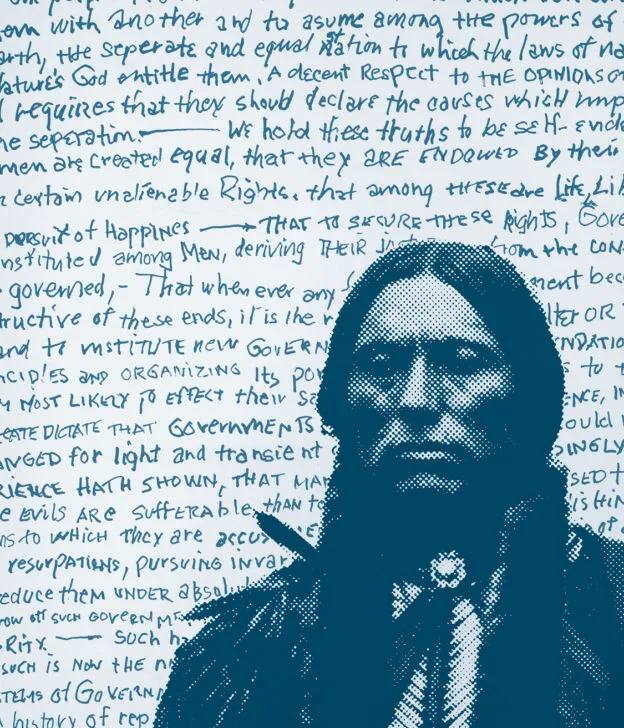
Our nation was made from a set of ideas including equality, liberty, and self-government. We are not a blood-and-soil nation with a single authorized form of worship. To say this fact does not disrespect our white Protestant founders; it honors them. For the radicalism of the idea that a nation could declare itself free and dedicated to the proposition that all men are created equal is still, a quarter millennium later, breathtaking.
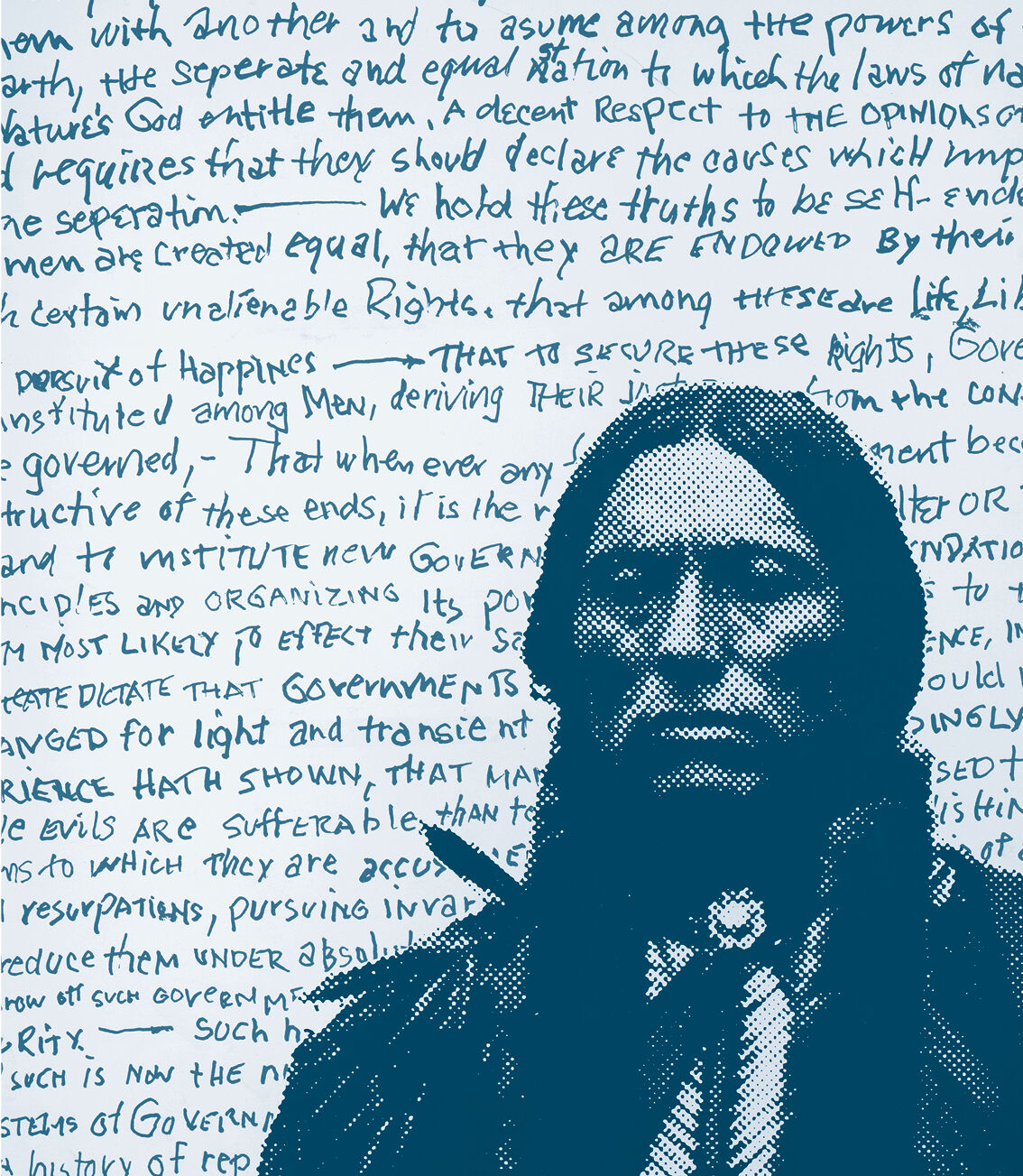
Even the most disappointed and disillusioned among us still have something to cherish. The very source of our disappointment and disillusionment is the American creed itself.
Alas, so is the gap between our creed and our deeds. There has always been such a gap in America. Perhaps there always will be. That’s not cause for cynicism, though. It’s a perpetual invitation to do better.
The ancient Roman Tacitus defined patriotism as “praiseworthy competition with our ancestors.” Think Jefferson was a hypocrite? Do better. Think we’ve gone off the rails ever since this person or that took office? Do better. Think today’s innovators have made our economy warped and our society sick? Do better. The 250th reminds us that true patriotism isn’t complacency or complaint. It’s closing the creed-deed gap.
We do that best not by gawking at political performers on our screens but by turning to each other, in person, rekindling habits of trust and mutuality and productive disagreement. When we recommit to the local, to place and relationship, we can convert disappointment into hope. Live the creed where you live, and America has a chance.
Of course, living the creed cannot mean following a formula. It is a matter of interpretation—of conflicting interpretations. The ideas of freedom and equality may be self-evident, but they are far from self-executing. They involve and invite fights over their meaning: freedom for whom, from what? Equality in what way, by what means?
Put simply, America is an argument. This is the second dimension of our national identity. What it means to be American is to fight forever over what it means to be American. And as they say in tech, this is a feature not a bug.
Baked into our founding documents and the history of our country is a group of fundamental tensions that set us up for perpetual conflict: liberty versus equality, diversity versus unity, strong national government versus local control, race blindness versus race consciousness, individual rights versus mutual responsibilities. Every conflict we face today recapitulates one or more of these fights, from disagreements about building more housing, mandating vaccines, teaching multicultural history, subsidizing struggling industries, policing immigration, taxing the rich.
What it means to be American is to fight forever over what it means to be American. And as they say in tech, this is a feature not a bug.
It’s OK to argue about such things. It’s important to argue about them. The trouble is that in too many civic arguments today an online style of discourse has infected real-world spaces. That style is historically illiterate, emotionally stunted, detached from lived experience, and more about posing than learning.
We don’t need fewer arguments in American life; we need less stupid ones.
People are beginning to realize this now. In 2023, Governor Spencer Cox of Utah, a Republican, joined with Governor Jared Polis of Colorado, a Democrat, to establish the Disagree Better initiative. Other governors and leaders from business, politics, sports, and popular culture have joined them as they’ve convened events and workshops on having hard conversations without contempt. Before those efforts, in 2017, I helped launch an initiative at the Aspen Institute called the Better Arguments Project. The project laid out five practices that capture some salient insights from the field: take winning off the table, prioritize relationships, pay attention to context, model vulnerability, and make room for transformation.
All these civic renewal projects proceed from a common premise: that trust is contagious. Where there is no trust, disagreement becomes combat; where there is trust, disagreement becomes co-creation. And this brings me to the third dimension of what it means to be American: our history of hybridity and unrelenting co-creation. In a word, combination.
One of the great tests of our civic imagination today is whether we will remember that being hybrid rather than pure is what makes America America.
As the son of Chinese immigrants, I believe that no matter how powerful China becomes in the years to come, the United States retains one competitive advantage: America makes Chinese Americans. China does not make American Chinese.
China does not want to make American Chinese. The logic of China’s cultural operating system is such that even if you or I became fluent in Mandarin and moved to Beijing for the rest of our days, we would always be outsiders, guests who are tolerated but not of the body, even I, whose face and hair and skin fit in. We would never have the cultural standing to redefine by our acts and ideas what the Chinese imagine to be Chinese.
By contrast, the logic of America’s cultural operating system is precisely to mix people, ideas, bloodlines, palates, and mindsets freely and to enable new hybrids to emerge from the mixing. Hybrids that redefine the way Americanness and American ideals get expressed; hybrids like jazz and the blues, kimchi burritos, and the Fourteenth Amendment of the Constitution that show the world what is possible in the recombinant glory of human existence. The logic of our operating system is to evolve.
That’s our inherent advantage in the United States—if we don’t blow it. We risk what makes our country great if we make ourselves smaller morally and materially by imagining ourselves a place made to serve a single race or religion or class. There have been times in American history, very long stretches, when our society has indeed blown it. We may be entering such a time now. But you and I are the authors of what comes next.
There is, of course, another word for combination: union. Union isn’t uniformity or unanimity. It presumes and requires diversity, of background and viewpoint and modes of sensing and solving. The power of our national experiment lies in the belief—the civic faith—that a people descended from every kind of human can form and sustain a union of unlike parts.
We redeem that faith not by our words but by our works. Live the creed, embrace constructive conflict, create new combinations that show the world what freedom makes possible. That’s what it means to be American today. That’s what it has always meant.

About the Author
ERIC LIU is co-founder and CEO of Citizen University and the author, most recently, of Live Like a Citizen: 8 Ways to Change Your Mindset and Our Country, from which parts of this essay are adapted.