
Boston Is a Brick City
David Hacin explains how Boston’s red brick nods to the Northeast’s character while preserving the city’s history for decades to come.
October 15, 2026
I first heard the declaration “Boston is a red city” almost 40 years ago, sitting in Piper Auditorium as a student at the Harvard Graduate School of Design. The lecturer was a visiting professor named Joan Goody, one of the first women to run a major architectural firm in the Northeast. Even before the colors red and blue had such binary political connotations, I found her statement simplistic, provincial. After all, cities were more complicated than that. The argument felt too prescriptive to me. In an academic setting where we were encouraged to explore radical ideas, Goody’s work felt, well, “commercial,” and I was consoled by other classmates for not having gotten my first choice in the lottery.
No consolation was needed. It was a great experience.
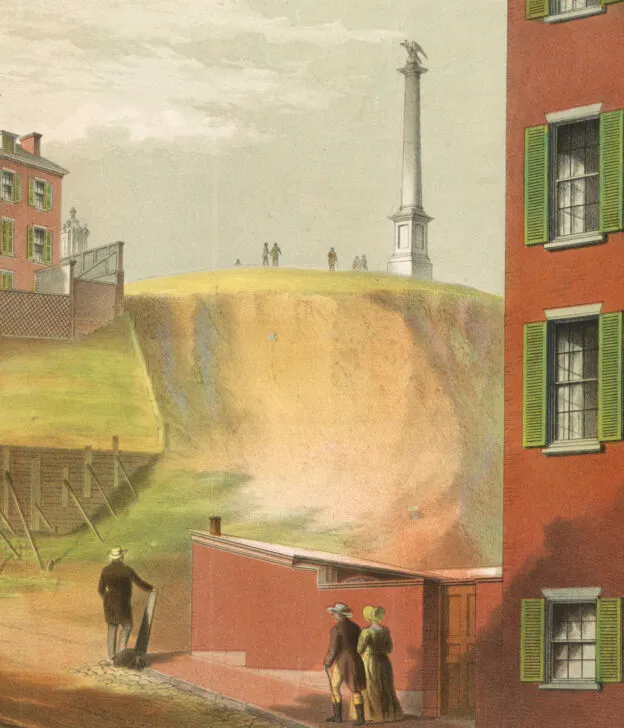
As I settled into my new city post-graduation, I observed Boston’s most recognizable neighborhoods were indeed made largely of red brick—even the sidewalks. It was beautiful and like almost nowhere else I had seen in America.
And weren’t many of the cities I had visited (and loved the most) similarly monochromatic? Paris was limestone and patinated copper; Jerusalem was golden hued; the red tile roofs of the Dalmatian coastline and the “old towns” of almost every notable European city were cast or quarried out of local materials that lent themselves to particular details, giving each region a distinctive identity—and color—worth celebrating and preserving.
Boston’s local characteristics were not only charming, but common sense suggested to me that this was a more authentic and sustainable way to build than an approach where so much was regularly torn down and replaced with new buildings built of materials that needed to be imported from long distances and had shorter lifespans. While cities need to grow and change in new and exciting ways, I grew skeptical of the need to “make a mark” that ignored the material context or scale of established districts. Our practice, rooted in just these kinds of places, studied the city’s built history and followed suit.
Brick first arrived in Boston and other settlements along the East Coast in the 1700s as ballast in ships from England at a time when there was little else but wood to build with. Masonry’s durability, flexibility, transportability, and warm color beneath grey skies were immediately embraced. Soon after, a local industry was born, and bricks were manufactured from the local clay deposits that provided their distinctive red hue. For centuries, red brick became the city’s dominant material for everyday construction, but it was also the first choice of architects working on distinctive local landmarks, from Charles Bulfinch’s State House to Alvar Aalto’s Baker House at MIT. More recent projects by out-of-town architects continue to honor that tradition with inventive solutions.
Today, despite those special projects, downtown Boston and the new Seaport is rapidly becoming a “blue city,” overwhelmed by the same steely cobalt reflective glass curtain wall systems that are making every skyline and cityscape look, depressingly, the same. At the neighborhood level, much of Boston’s character is being overwhelmed by cheap-looking panelized facades of the kind that have given rise to the term “fast-casual architecture” for its resemblance to drive-throughs and suburban strip malls. New housing is desperately needed but, in all respects, the price has been steep.
A few years ago, our firm was commissioned to design a new hotel on an open lot at an important gateway intersection leading into Beacon Hill. The project involved the adaptive reuse of an early twentieth century dormitory building that in most cities would have been sacrificed to create a more efficient development site. Adjacent to it, we were to design a new four-story addition. The iconic, heavily regulated neighborhood is the closest thing Boston has to a UNESCO world heritage site, so we thought carefully about what to propose. It was one of the most prominent commissions we had ever been given, and the temptation to create a bold, high-contrast design statement was strong. Instead, we carefully studied the contemporary possibilities of working in brick and other local materials. The new addition, built through the winter, was concealed from view by heavy white tarps of building wrap.
In early spring, I got a call from the general contractor: The tarps were coming down and I should come over right away for the big reveal! Racing over and armed with my iPhone, I stood across the street to take video, when someone in a hard hat rushed across the street to come speak with me.
“What are you taking pictures of?” he asked defensively.
I said I was the architect, here to document the moment. His face brightened, and he thanked me profusely for designing in brick. His company was a locally owned, multigenerational masonry business and, even though the city was booming, there was less for local masons. He was worried for his family and his crews. Our project—with its custom brick shapes and details—showcased their abilities and craftsmanship. More thanks. “Don’t people understand that all this panel s*** will need to be replaced in 20 years? Brick is forever—and it’s Boston.”
I nodded and thanked him as well. I already saw the quality of the brickwork was exceptional. We shook hands vigorously, and he raced back across the street to climb up into the scaffolding. A few weeks later, I went back to take more pictures from the same vantage point. The facades had been cleaned and the sun was out, helping cast sharp shadows on the masonry. This time, another man came up to me, holding his young daughter’s hand. “You’re the architect, right?” It was my turn to feel defensive. (Here it comes . . .)
“My wife and I love it! The brick is so beautiful and different—but it still feels like the Hill. We were so worried when it was tented up in white for so long. After all, you architects like to—” He stopped himself. “Anyway, thank you for fitting in. The neighborhood thanks you, too.”
I was genuinely surprised. That had never happened to me before. As they walked away, I thought about the local masons who had built the building. They might even bring their families by to show off their work. And what about that man’s daughter? What kind of place would this be when she was my age?
And then I thought back to my professor, who had, in subsequent years, become a colleague and a friend. Architect, civic leader, and ocean sailor, Joan lost a tough battle with cancer in 2009 before the full scope of the threat of rising seas to her “red city” was fully grasped by any of us. But now I see that she had understood quite a bit already. Preservation and building locally was an important way of thinking globally.
A wise woman. Ahead of her time.

About the Author
DAVID HACIN is the President and Creative Director of Hacin, an interdisciplinary architecture and design firm founded in Boston. He has spent his career collaborating on projects that strengthen ties to communities and their surrounding contexts. This article was originally published in Common Edge.