
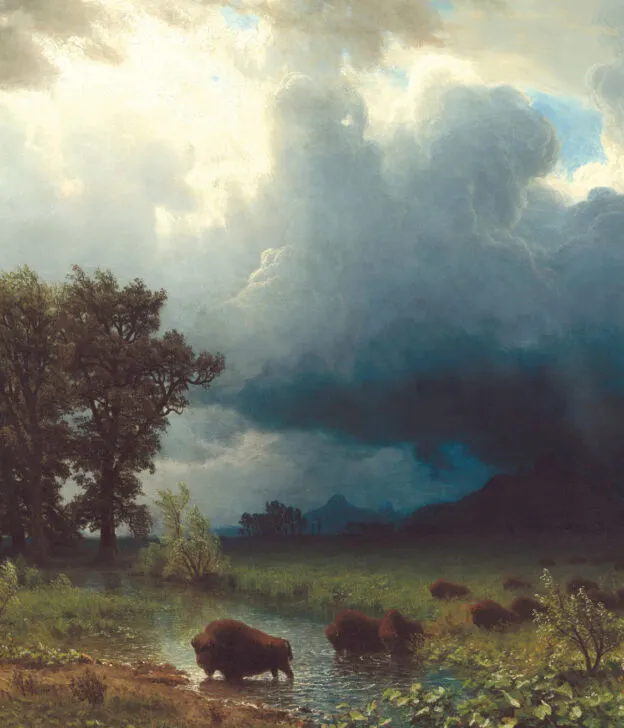
Citizens on an Adventure
Rachel Mackey reflects on her experience growing up in the American Southwest, and what Western art can teach us about the American spirit of adventure.
October 15, 2026
Every year I take the students of Hudson Institute Political Studies to the National Gallery of Art in Washington, D.C. to consider political questions through the medium of art. Looking at the works of Giotto, da Vinci, and Rembrandt, we consider what it means to be a human being. Then, taking in the art of Jacques Louis David, Gilbert Stuart, and Augustus St. Gaudens, we ask what it means to be a citizen.
The answers are easy in the old world—to be a human being is to be a creature of God or of the city; to be a citizen is to fight for Florence, or follow Napoleon. But as we cross the Atlantic the questions are more complicated. As Americans we do not share a God or an ethnic identity. We have not all lived next to each other for hundreds of generations.
The first painting we look at is Albert Bierstadt’s Buffalo Trail: The Impending Storm. Known for his awesome landscapes that span the Hudson River Valley, the great grass prairies, and the Sierra Nevada, Bierstadt here depicts a line of buffalo coming toward the viewer across grass and creek. The end of the buffalo line disappears into a rising storm. America is a place of exploration, undiscovered landscape, untouched ground—a new nation built by adventures from across the Atlantic. With this definition comes tragedy, or at least, the unknown. The buffalo cannot outlast the storm of civilization. The end of the adventure will come.
Growing up in New Mexico, the vestiges of the frontier, Bierstadt’s answer and the problem inherent in it seem especially real to me. My brother and I spent our weekends hiking through almost untouched deserts, swimming in natural waterholes with real rock slides, avoiding rattlesnakes under the red rock ledges. We could almost imagine that no one had been there before us, that like Lewis and Clark we could write back to civilization—“Look at the wonderful world we have found.”
But the tragedy was there too, in the broken beer bottles we came across on the path, the poverty of the state, and the knowledge that our beautiful home would not be the place I would bring up my own children. Civilization had come to New Mexico, and with it the end of the adventure, at least for the adult world, but it had not brought with it a new answer to the question of American identity.
Gilbert Stuart’s “George Washington” provides an alternative answer. Painted after the death of Washington it depicts Washington after he has resigned the presidency. His clear blue eyes confront his visitor from a somewhat worn face. His dark frock coat reminds us that he is now a private man. He is the Washington who led the Revolutionary War, who was unanimously elected president, but most clearly he is the Washington of the Farewell Address. He seems to be expecting something of us, expecting that we will live up to his standard.
Coming out of the Gallery with the memory of those piercing blue eyes we see the National Mall with its monuments and museums—and the crowds that come to view them. If you look at the lines of school children waiting to view the Constitution and Declaration you can see citizens on an adventure—an adventure in keeping with Washington’s expectations.

About the Author
RACHEL MACKEY is a fellow at Hudson Institute, and the executive director of Hudson Institute Political Studies, which provides exceptional students with an education in the theory and practice of politics. She received her PhD from Boston College.