
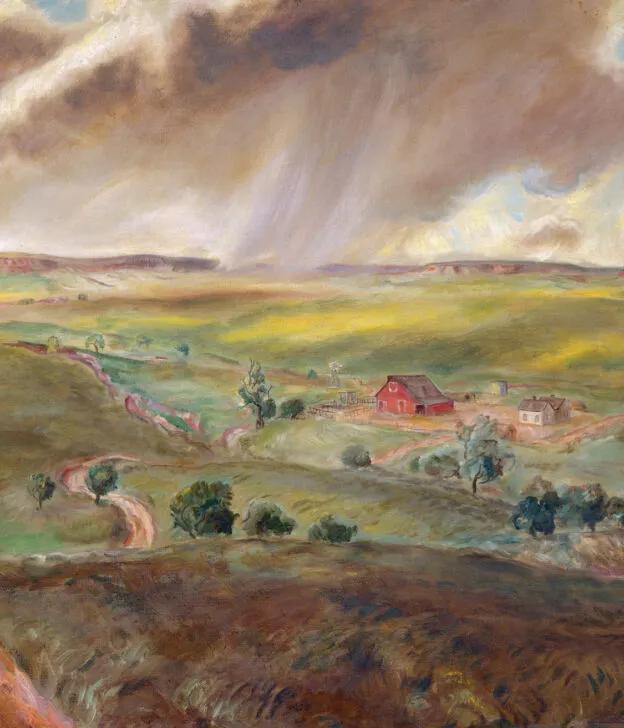
Flyover Country Is America in its Essence
J.R. Gage reflects on how the Great Plains are the actualization of American idealism.
October 15, 2026
In America’s popular imagination, at least, the Great Plains region is flyover country. Folks from the coast seem to think it is all corn, cattle, retrograde politics, and college sports.
Important as those may be, the significance of the Great Plains goes far deeper. Since the Founding itself, the Great Plains has been nothing less than the most quintessentially American part of America.
Beginning in 1776, American idealism has always meant the national self-actualization of the words “life, liberty, and the pursuit of happiness.” Settling the west and the increase of American wealth and power have all been towards this goal to create what Thomas Jefferson called “an Empire of Liberty.” Pioneers were inspired to build a civilization out of a wilderness. Perhaps no accomplishment represents American desire for conquest more than the taming of what was once referred to as the “Great American Desert.”
That is why, in thought and action, no part of the country has been more dedicated towards this ideal than the Great Plains. The region is truly American-made, having been purchased, settled, and institutionalized after the nation’s Independence. On this frontier, brave men and women built up the republic as they intended it, without the baggage of history or the prejudices of the Old World.
That idealism also manifested during the Civil War in the willingness of the states that make up the Great Plains to fight with the Union. In the years following, no region better embodied American optimism, and its culmination could be found in populist figures rising from the west at the turn of the twentieth century such as William Jennings Bryan. The Great Plains also foreshadowed the rise of the twentieth century Civil Rights Movement with the victory of Nebraska native Chief Standing Bear in federal court recognizing the humanity of American Indians.
Other American greats were born, raised, or educated here: Malcolm X, Teddy Roosevelt, Crazy Horse, and Buffalo Bill. Even now as the country ages and many feel its best days are behind it, no region is more loyal to conservative sentiment or the ideals of the Founding.
As the region urbanizes, the Great Plains continues to be defined by its rural roots. In a recent visit to western Nebraska, a Sandhills rancher showed me the spot under a Black Locust tree where homesteaders built the first sod hut on the land his ancestors have lived on for six generations. Nearby, metal remnants of pioneers’ wagons can still be found.
This rural-consciousness extends to the many folks in the region that have abandoned the countryside for suburban living. A writer for Vanity Fair wrote in 1932 that “A true Nebraskan feels ill at ease on [Omaha’s] steep hills.” This suspicion of cities can be found throughout the Great Plains and explains the suburban sprawl that many coastal Americans find off-putting.
The pioneering memory can also be found in the naming of sports teams in the Great Plains—the region’s favorite pastime. Nebraska Cornhuskers, North Dakota Fighting Sioux, and the Wyoming Cowboys.
Along with its virtues, the Plains reflect the peculiar simplicity of American culture. Oscar Wilde once said, “America is the only country that went from barbarism to decadence without civilization in between.” Outside of the novels of Willa Cather and Laura Ingalls Wilder, the region has produced few great artists. In my home state of Nebraska, public spaces are littered with art that ranges from kitsch to garish.
Neither European aristocratic airs nor refinement have penetrated deeply into the Plains’ cities, contrasting with places like New York and Charleston. The people of the region have neither the triumphalist earnestness of the Northerner nor the conquered pessimism of a Southerner. Instead, the Great Plains offers American identity a kind of hopeful balance between permanence and change.
While for many, the Plains will continue to be forgotten as flyover country—maybe as we celebrate America’s 250th anniversary, its future and renewal still remains in the West.

About the Author
J. R. GAGE is a political and cultural commentator living in the Midwest and an alumnus of Hillsdale College. He is the executive editor of The Plains Sentinel.