Mount Vernon’s Civic Education
Catherine Waddell explores what George Washington’s Mount Vernon can teach us about our individual responsibility as citizens.
October 15, 2026
Today, understanding what it means to be an American is at risk. Too often we take for granted what requires hard work to maintain—and taking something for granted obfuscates what can be lost. Therefore, those who do understand what it means have a responsibility to safeguard our history to ensure that all Americans may live according to the values set forth by our founders.
We must practice our history every day, or we will lose it. For me, being an American ultimately means taking responsibility for ensuring that the idea of our free nation, the ideals of our founders, and the practice of our precious history remain foremost in the minds of all Americans.
In 2013, I became the 7th Vice Regent for Illinois for the Mount Vernon Ladies’ Association of the Union (MVLA), the governing board of George Washington’s Mount Vernon. Formed in 1853 by a group of enterprising women whose purpose was to acquire and restore Washington’s beloved home, the MVLA raised $200,000 and bought Mount Vernon from Washington’s nephew in 1858 and has owned it without interruption to this day. The MVLA remains a board of women from states across the country and is responsible for the preservation of the estate and teaching the world about the life and legacy of George Washington. It accepts no government funding.
The MVLA is my national service. It is through work with my colleagues at Mount Vernon that I practice our history and take responsibility for helping to ensure that all Americans know what it means to be an American, to be free, and to live in a democracy. In a time when fewer than 30% of voting age Americans can name the three branches of government, I realize that much of our way of life is taken for granted, that civics and history are losing their importance in the classroom, and perhaps even worse, that the very notion of democracy is being questioned.
When I was a young girl, I was fortunate to have parents who were very interested in U.S. history. We visited historic sites and ate cherry pie every year on George Washington’s birthday. Christmas and birthday presents always included books related to the Revolutionary War or our nation’s founding. I was also fortunate to attend an elementary school in which we recited the Pledge of Allegiance everyday and celebrated both Washington’s and Lincoln’s birthdays. We learned about the branches of government, elections, and voting.
Those were impressionable years that instilled in me a love of country. It felt good and right to be patriotic. I was proud to be an American citizen. I want that experience for all children so that they will adopt a love of country and be inspired to protect our democratic way of life by understanding our founding documents, knowing our history, and exercising their right to vote. I want that for my grandchildren—and for all Americans. Places like Mount Vernon exist, in no small measure, to help provide it.
Understanding what it means to be an American evolves, I have moved from taking my way of life for granted, to working hard to preserve, in the words of George Washington, “the great experiment” that is our democracy and our government: a government of, by, and for the people.
I have been to places where women in public must be escorted by a male relative or husband, in places where women may not dress as they choose, in squares where protests have been bloodily suppressed, and where all citizens must register to travel from one province to another. Not until travel took me to places where these freedoms and others are limited or don’t exist, did I truly understand what it means to live in a free country, to be a free citizen, and to enjoy those freedoms. How quickly I stopped taking seemingly basic freedoms for granted. Being an American means being free.
And our freedom is protected by the rule of law under our Constitution. Our founders made sure of this. I was fortunate one time to be in the company of Lady Margaret Thatcher who commented that Americans must not forget that they are the only nation founded on the idea of liberty. We did not inherit a form of government; we fought to create a republic rooted in Enlightenment ideals. Being a modern day American is knowing that you are the intentional consequence of two battles, one of brains and one of blood, each fought in order to break free and to live freely.
At Mount Vernon, we take responsibility for ensuring that George Washington’s vision for the new nation is neither taken for granted nor lost. We work hard each day to teach his life and legacy.
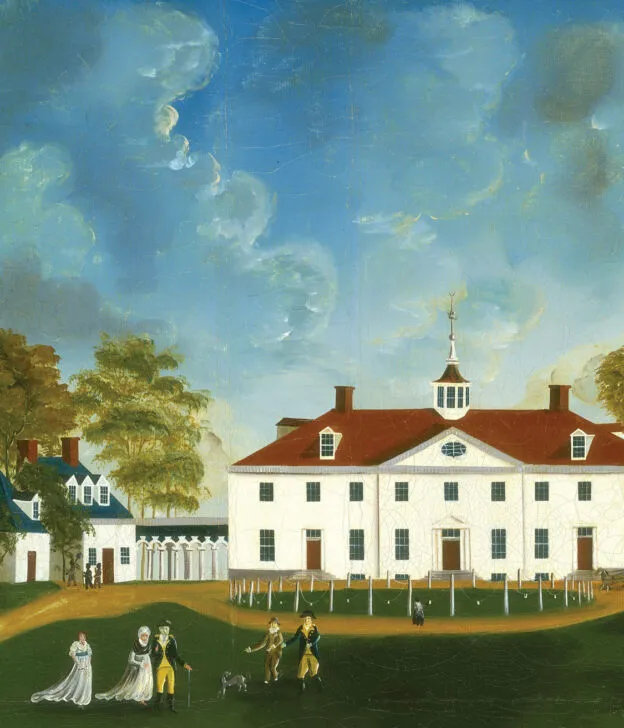
Here visitors of all ages can see the mansion in which Washington lived, the beloved farm he left behind to lead the Revolutionary War, the study from which he formed the new government, and the bed in which he died. The Education Center tells both the story of Mount Vernon and the story of Washington himself. The George Washington Presidential Library is a place of scholarship and research. It is home to many of Washington’s papers and books, and is a place to which historians turn to study the founding era through books, manuscripts, and rare maps. It deepens the meaning of who we are and are capable of being.
Mount Vernon represents what it means to be an American. At this place, George Washington’s imprint upon our nation, who we are and for what we stand, is inescapable. I am humbled by the stories of those who fought with words and bayonets to secure the nation that is ours. I am struck by Washington’s perseverance to achieve his vision, and I am inspired to take responsibility for our nation’s future.

About the Author
CATHERINE MARLETTE WADDELL is Mount Vernon Ladies’ Association’s Vice Regent for Illinois.