State Constitutions and America’s Civic Tradition
Americans have adopted more than 200 state constitutions. Drew Kurlowski shares how constitutional preambles reflect our shared values.
October 15, 2026
Americans have adopted more than two hundred state constitutions. Louisiana has had eleven, Georgia ten, South Carolina seven. States have ratified upwards of 11,000 amendments. We have rewritten the fundamental charters of our states about every 22 years. While this relatively rapid revision is not too far apart from the rate at which the rest of the world’s nations have replaced theirs, it is in stark contrast with the permanence of our federal Constitution. But from our founding to today, despite all the changes in the body of the texts, we altered very little about the words in our preambles.
What does the study of state constitutions—and especially these preambles—tell us about what it means to be an American? That we are a people who have sat down hundreds of times to write out who we are and were never willing to finish the phrase “We the people” with a qualification. The machinery that came later expanded and contracted the franchise, it expanded and contracted rights, but the preambles never moved. Our founding sentences refused to foreclose on us, and not for lack of people who wanted to.
Take, for example, the August 1890 Mississippi state constitutional convention which was called to address the topic of suffrage. In the words of the convention’s president, Solomon Calhoon, “We came here to exclude the Negro. Nothing short of this will answer.”
The delegates did it, thoroughly in writing, and affixed their names to the document. The opening sentence of that document, however, simply said:
We the people of Mississippi, in Convention assembled, grateful to Almighty God, and invoking His blessing on our work, do ordain and establish this Constitution.
Twenty-five words that were not exclusionary—just simply the people, and a request that God bless their work.
This juxtaposition is not a peculiarity of Mississippi, or the South, but rather a central feature of American constitutional writing. Conspicuously missing are the words “white,” “Christian,” “English-speaking,” “native-born,” “male,” or “property-owning.” Not in the secession constitutions of 1861, not in the Jim Crow constitutions of the 1890s, not in the 1895 South Carolina preamble which dedicates the document to “the preservation and perpetuation” of liberty. For a short time we see the word “freemen,” but by the twentieth century it vanishes.
The drafters of these documents were not squeamish. They codified the poll tax. They conceived the grandfather clause. They itemized the machinery of disenfranchisement and exclusion and defended it in speeches. But they never put it in the first sentence. They never restricted the preamble.
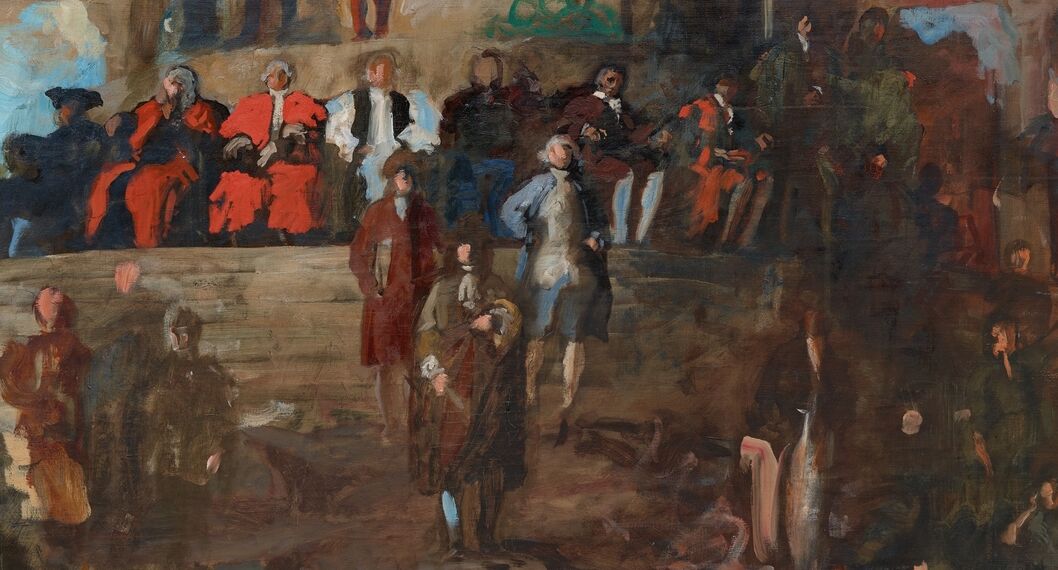
Conspicuously missing from state constitution preambles are the words “white,” “Christian,” “English-speaking,” “native-born,” “male,” or “property-owning.”
Now perhaps we could argue that these framers simply weren’t paying attention to the words. Idaho’s 1890 preamble is nearly identical to Ohio’s of 1851. Forty years, and 2,000 miles, but the text remains unchanged. Rhode Island, New Jersey, and Illinois all use a phrase that thanks God for the liberty that “He hath so long permitted us to enjoy.” An open preamble might have simply been the template.
This explanation, however, misunderstands what a template is. Boilerplate is not the opposite of conviction, but rather, it is what conviction looks like once people stop arguing over it and simply start copying it. The openness of America’s preambles had become so ordinary that even those constitutional conventions focused on racial exclusion inserted them without any apparent discomfort.
This form is not necessarily commonplace internationally. Hungary’s preamble discusses King Saint Stephen and how he made the country part of “Christian Europe.” Turkey’s discusses the “historical and moral values of Turkishness.” A full 25 percent of national constitutions express a national identity in their preambles.
So why does it matter that constitutional exclusion, when it appeared, lived in the text and not the preamble? The gap between the first sentence and the exclusionary text, pages later, is not a hypocrisy; indeed, it is the mechanism of the tradition. Thomas Jefferson wrote that all men were created equal while owning people, but that sentence would become central to the effort to free them. Frederick Douglass argued from our founding documents, not against them. Martin Luther King Jr. called the Declaration a promissory note. And we found ourselves in default of that promise because it was written so openly.
Our ability to appeal to open definitions of ‘we the people’ is possible because no convention, even the ones convened for the explicit purpose of exclusion, was willing to narrow the definition of the people in its preamble. They disenfranchised, but they did not disown, and thus everyone, those with and without the franchise, could point to the first sentence and say ‘I am one of those people.’
Finished texts have a limit. They merely record what a convention adopted, and not what it considered. We cannot authoritatively say whether anyone ever moved to insert “white” into a preamble and lost the vote, or whether it even occurred to them. We would do well to consider the entirety of the negotiations surrounding our governing documents. The work of the Quill Project does exactly this. Reconstructing the making of these documents helps to shed more light on not only what Americans were willing to agree to, but what they refused, what they never thought to say, and what they could not bring themselves to write.
For all our nation’s failings, the promise of these preambles offers something better and more durable. The sentence left open, left unqualified by those who had every reason to qualify it, used for 250 years by those who were shut out, giving hope and promise to the marginalized, an open door waiting to be walked through.

About the Author
DREW KURLOWSKI is Associate Professor of Political Science at Coastal Carolina University. He is a scholar of political participation broadly and is the founding co-director of the Cincinnatus Center.