
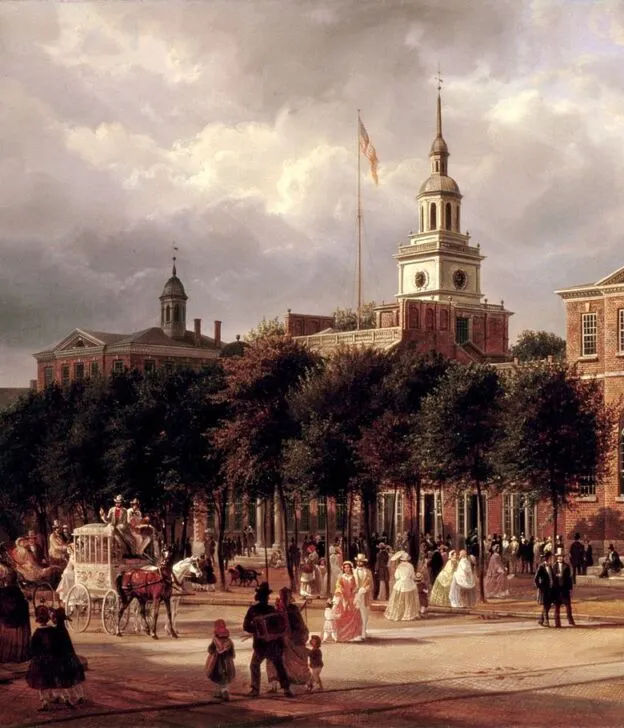
The Parthenon of the Republic
D.G. Hart’s new history of Independence Hall documents the building’s iconic events and how later generations try to remember them. JMC President Hans Zeiger reviews this new book for Law & Liberty.
October 2, 2026
When Jeffrey Rosen was the president and CEO of the National Constitution Center in Philadelphia, he would open events in the Center’s stunning Great Hall Overlook by asking the audience to pause and look out the windows. There, across stretches of park lawn, stands Independence Hall. That’s where Washington was sent out to lead the revolution. That’s where the founding documents were debated and signed. That is where the nation began. And the building is still there for us to see.
Perhaps we take that for granted, and perhaps that’s why it is such a remarkable thing to look out the windows at Independence Hall, and to really take in the sight. It is exceptional for any building from the eighteenth century to still be standing, but Independence Hall remains.
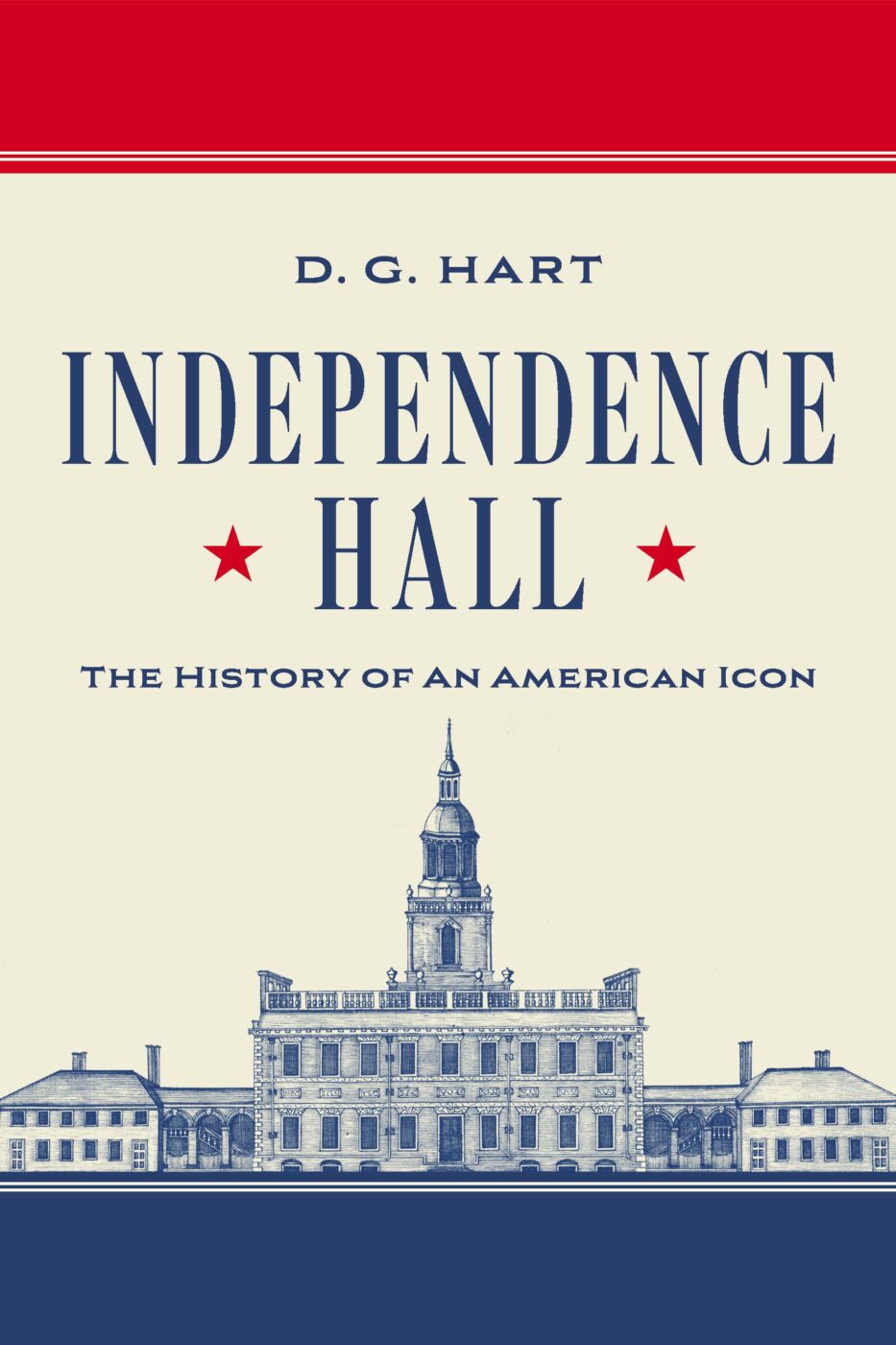
Now D. G. Hart has written a history of Independence Hall that teaches us not only what happened there but also how subsequent generations tried to remember it. Despite the imperfections of memory, those walls still stand and serve as a reminder, aided now by Hart, of “the course of human events” that transpired there.
Some of those events are famous, and others should become so. For example, Benjamin Franklin’s role in the Second Continental Congress and the Constitutional Convention is widely celebrated. Less known is the fact that he served as the clerk of the Pennsylvania General Assembly beginning in 1736, just as the assembly began meeting in the building that would later be called Independence Hall. Franklin spent decades of his life making institutions in Independence Hall in one way or another. Also beginning in 1736, Franklin’s Library Company made use of space at Independence Hall, where it continued to keep books until 1773. And after Franklin co-founded the American Philosophical Society in 1743, the scientific organization convened many of its meetings at Independence Hall. As Hart puts it, “Without the State House, Ben Franklin would not have become who he was, and without Ben Franklin, Pennsylvania’s capital would not have become home to the American founding.”
So Independence Hall was a site of colonial governance and civil society before it became the essential place of American independence and the Founding. And in an era before easy access to watches, the clocks and bell of Independence Hall served as “a common reference for meetings, appointments, and opening shops.”
When the Declaration of Independence emerged from Independence Hall in 1776, it too was a kind of common reference point for Americans, and eventually for free people everywhere.
The Declaration was the most famous work of the Second Continental Congress, whose delegates from throughout the colonies had gathered in Independence Hall beginning in 1775. It was this consequential Congress that created the Continental Army and selected General George Washington as its leader. Theirs was the task of “raising, financing, and managing the war with Britain,” writes Hart. Organized in 59 different committees ranging from finance to military supply to war correspondence, the Congress was as much a central management bureau for the Revolution—Independence Hall was “America’s first military headquarters,” as Hart calls it—as it was a deliberative body.
But Independence Hall was at its best when it served “as a space to debate ideas,” writes Hart. Here it was that the five-man committee of John Adams, Benjamin Franklin, Robert Livingston, Roger Sherman, and most importantly Thomas Jefferson reported back to the Congress with their draft of the Declaration that would change the world.
For those who have visited Independence Hall and for those who have yet to see it, D. G. Hart has given us a valuable biography of the nation’s founding site.
The following year, during the British occupation of Philadelphia, Independence Hall was turned into a prison and hospital. When Congress returned from its temporary home in York, Pennsylvania in 1778, the building was in a “most filthy & sordid condition,” according to Josiah Bartlett, a delegate from New Hampshire and signer of the Declaration. But Congress wasted no time getting back to work on the prosecution of the war, spending much of its time now on diplomatic matters like the alliance with France. “Without the war powers of America’s first government,” Hart writes, “the Declaration of Independence would have been simply a statement of political theory and a list of colonial grievances.”
Fast-forward nine years after Congress returned to Independence Hall, it would again become a scene of national deliberation—namely, about how people would govern themselves through deliberation. Just a few months later, the Pennsylvania ratifying convention gathered in Independence Hall and voted in favor of the Constitution.
After that, Independence Hall continued to serve as Pennsylvania’s state house until the legislature relocated the capital to Lancaster in 1799 (and to Harrisburg in 1812). Since then it has largely served as a museum. Starting in 1802, the great portraitist Charles Willson Peale set up a portrait gallery and museum on the second floor of Independence Hall.
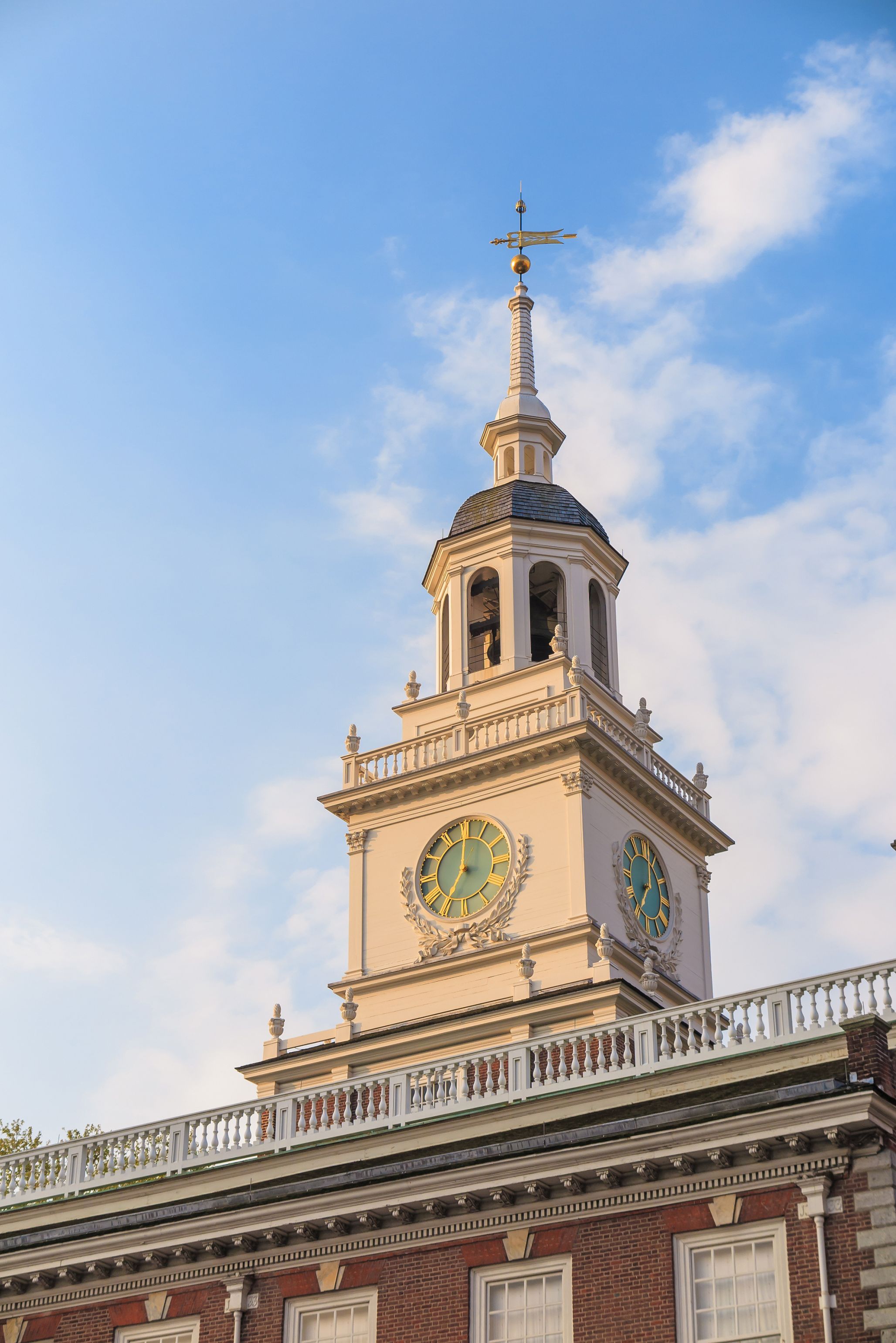
It was the return of the Marquis de Lafayette to Philadelphia in 1824 that inspired a new sense of historical memory for Independence Hall, where the French hero of the American Revolution delivered an address on the meaning of American independence. “Here within these sacred walls, by a council of wise and devoted patriots, and in a style worthy of the deed itself, was boldly declared the independence of these vast United States,” he proclaimed, before taking nearly three hours to greet Americans who had come from near and far to see him. Four years after Lafayette’s visit, the City of Philadelphia commissioned the steeple for the building’s bell tower that still stands today, and in 1831, the city restored the appearance of the main Assembly room as it had been in the time of the Continental Congress, at least by the interpretation of architect John Haviland. Another restoration of the Assembly Hall occurred for the 1876 Centennial Celebration.
Independence Hall stands with the Parthenon of Athens and the Colosseum of Rome as a UNESCO World Heritage Site. But its fame and importance are not because of its architecture but rather because of the work that happened there. In fact, as Hart points out, the sole reason that Independence Hall was designated by UNESCO in 1979 was because of the documents that were written and adopted in its walls. According to UNESCO itself, the “universal principles of freedom and democracy” found in the Declaration of Independence and Constitution had a profound influence on “lawmakers and political thinkers around the world.” Independence Hall, wrote the UNESCO judges, is America’s “most important historical site.”
So it remains. When Ronald Reagan went to Independence Hall for the Bicentennial of the US Constitution in 1987, he spoke of great events that had occurred there since the constitutional convention, including Abraham Lincoln’s speech en route to his inauguration in 1861. And he referred to the moment of the Bicentennial itself. He called on citizens to visit “and hear the echoes and sense the greatness and draw strength.”
Indeed, each American should make a point to visit Independence Hall in his or her lifetime. It is a civic ritual that would remind us, as Franklin once said, that we have a responsibility to “keep” the republic. For those who have visited Independence Hall and for those who have yet to see it, D. G. Hart has given us a valuable biography of the nation’s founding site.
Hans Zeiger is the president of the Jack Miller Center.