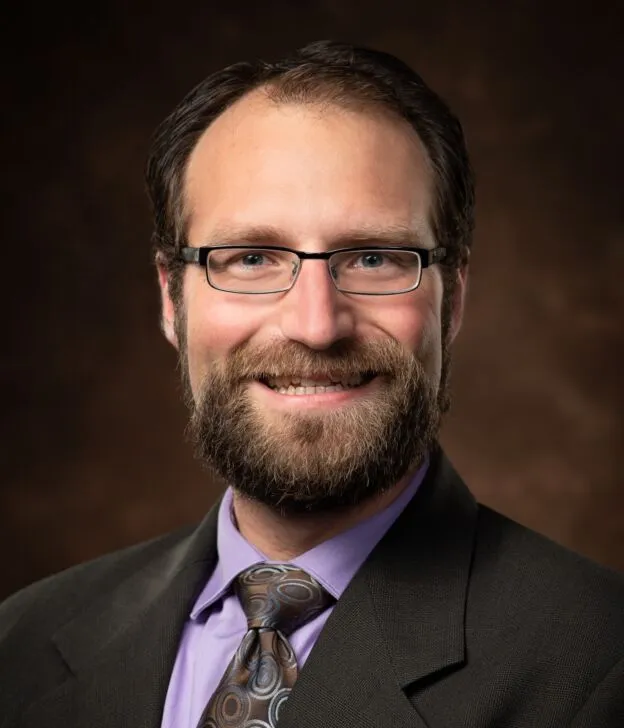
An interview with Consortium Professor Benjamin Gross
Dr. Benjamin Gross is Associate Professor of Political Science and directs the Center for Leadership and American Principles at Jacksonville State University. In addition to running a Summer 2026 graduate course entitled “Teaching American Civics,” Professor Gross facilitates JMC’s partnership with the Jax State M.S.E. in Secondary Social Studies Education, which accepts transfer credits teachers earn through the Graduate Consortium.
October 11, 2026
JMC: How was your experience teaching a Graduate Consortium course?
BG: I had a great time teaching the graduate course. I found it really rewarding to engage with students who not only wanted to learn about the principles, ideas, and core moments of American Political Thought but also bring those topics into their classrooms. Moreover, it is both unique and powerful to bring people from different geographic places into one classroom because it brought ideas about America from across the country into conversation with each other.
JMC: How would you describe teachers’ engagement, both in terms of participation and the kinds of questions or connections they brought to class?
BG: For many students, this was their first time doing a Socratic seminar, so they weren’t initially confident in their participation. They were used to a professor lecturing and telling them what was important, instead of inviting them to think for themselves. Throughout the course, I saw significant growth in the students. Many who began quiet were very talkative by the end. This growth was important to the teachers and inspired them to bring Socratic seminars back to their classrooms.

JMC: What did you learn from teaching K-12 teachers?
BG: After teaching this course, I became much more familiar with the challenges that face teachers, such as limited access to or time with students, the ways they have to hit state standards, challenges with the bureaucratization of education, and the lack of content that teachers are exposed to because so much of professional development is classroom management and pedagogy. These educators want to teach; and they want to knowledgeable in their craft. The teachers said the course was the most meaningful access to content they had had in 10-15 years. In this way, the course gave teachers an invaluable opportunity to hone their craft and develop their own knowledge.
JMC: How did you adapt your syllabus and teaching for an audience of K-12 teachers?
BG: I didn’t adapt the syllabus much. The biggest adaptation was condensing a semester-long class into a two-week accelerated course. I had to pick and choose topics because I could not teach everything. I built the class around topics that hit state standards so it would be the best bang for the buck for K-12 teachers. I didn’t adjust the readings; teachers read what American Political Thought graduate students read in my seminars.
JMC: Which readings, assignments, or activities worked especially well in your graduate course?
BG: I used reading quizzes as a low-stakes assessment, and I was surprised by the positive response from teachers. Many wanted to implement similar quizzes in their own classrooms. Additionally, the reflection papers worked well because I could give feedback and see growth throughout the course. Assigning teachers lesson plans allowed them to complete work that was practical for their classrooms. I liked the format of teaching the course for two weeks and giving teachers the remaining three weeks of the summer session to work on their final projects. I also facilitated teachers sharing lesson plans which built a community of practice.
JMC: Why should universities join the JMC Graduate Consortium?
BG: It is a duty for universities to train teachers because universities are public stewards. Institutions of higher learning must provide a meaningful education in American principles and ideas. Offering accessible graduate courses for K-12 teachers is one way to meet this obligation.
By participating in the Consortium, universities can work collectively, which is not always possible in higher education. The Consortium lets member universities expand their reach across the nation while working toward a common goal with their peers. The Consortium also creates space for universities to play to their strengths. For Jacksonville State, this has meant leaning into its strength as a teacher-training institution while also connecting enrolled teachers to universities with content strengths in the American Political Tradition. Through the Consortium, member universities can contribute to something stronger and more impactful than any institution can do on its own.
JMC: Were there moments when a teacher’s classroom experience changed how you understood or taught the material yourself?
BG: I was very interested to learn that most of the teachers in his course taught the Declaration of Independence as a “break-up letter.” This framing was new to me, and it opened a rich discussion about how they teach the “break-up” alongside the Declaration’s principles.
I also learned that the teachers had developed ways of thinking about documents that reframed some of my discussions on historical context. Due to time constraints and other challenges teachers face, they often rely on information from common textbooks, websites, and other sources that don’t always offer a complete picture of primary sources and historical topics. This realization affirmed for me the importance of creating time for teachers to think deeply about these sources and topics on their own, with scholars, and with their colleagues.
JMC: What do you hope teachers carry from your course back into their own classrooms?
BG: I hope they bring back a deeper appreciation for the work they do. I hope they realize they are not just teaching to give grades; instead, the core of their work is teaching students to think about being citizens in a meaningful way. Teachers shape future citizens, and they have a responsibility to build this foundation so their students can achieve the promises the Founding offered us. These promises are, of course, still in progress, but bringing primary sources into classrooms and engaging students is vital to their civic life.
The Civics Foundations Graduate Consortium is a partnership of universities committed to offering graduate education opportunities to K-12 civics and history teachers. Consortium courses are taught by top scholars at universities across the country and are designed to help teachers deepen their knowledge of topics in American civics and history from the founding era to modern American political thought. The virtual courses emphasize content mastery and teaching with primary sources.