
Hamilton, Jefferson, and the American Idea
What separates Rosen’s work from others is the fact that The Pursuit of Liberty does not attempt to select a winner in the Hamilton-Jefferson debate. Rather, it celebrates the clash between the two competing constitutional visions, which has made the continued success of the American experiment a reality.
January 1, 2026
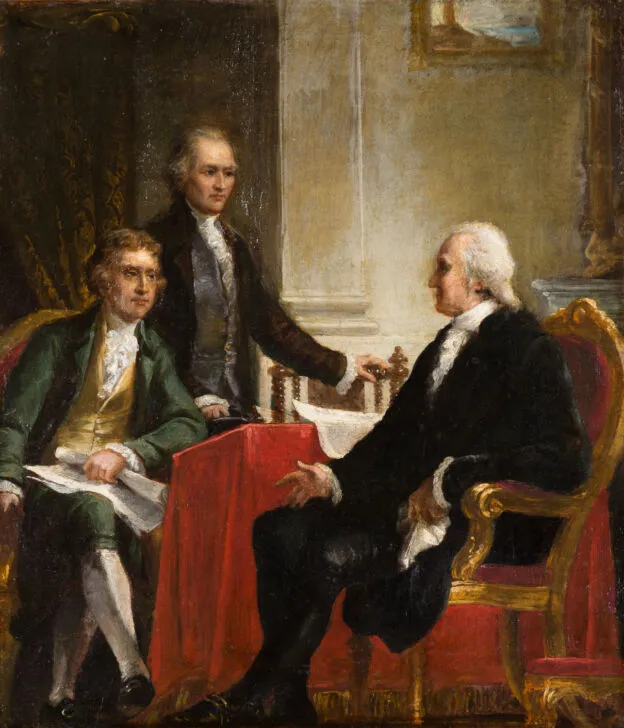
The battle between the power of government and individual liberty has been the enduring struggle throughout American history. When Thomas Jefferson penned the Declaration of Independence in 1776, he had in mind three principles for these United States of America: liberty, equality, and government by consent. These formed what we might call the “American Idea,” which was enshrined in the new written state constitutions adopted throughout the late 1770s and 1780s. During the fierce ratification battle over the Constitution, Alexander Hamilton penned his own explanation as to how this American Idea was enshrined in the newly proposed federal Constitution in The Federalist.
Jefferson and Hamilton both agreed on the American Idea in principle, though they came to different conclusions when defining between liberty and governmental power in the Constitution. A supporter of local self-government and state sovereignty, Jefferson’s philosophy was exalted by states’ righters throughout American history. Hamilton, on the other hand, believed in a vibrant national government with expansive congressional power that could secure liberty through a strong military and economy. Their different interpretations on the scope and nature of governmental power helped shape every major political and constitutional debate since the 1790s.
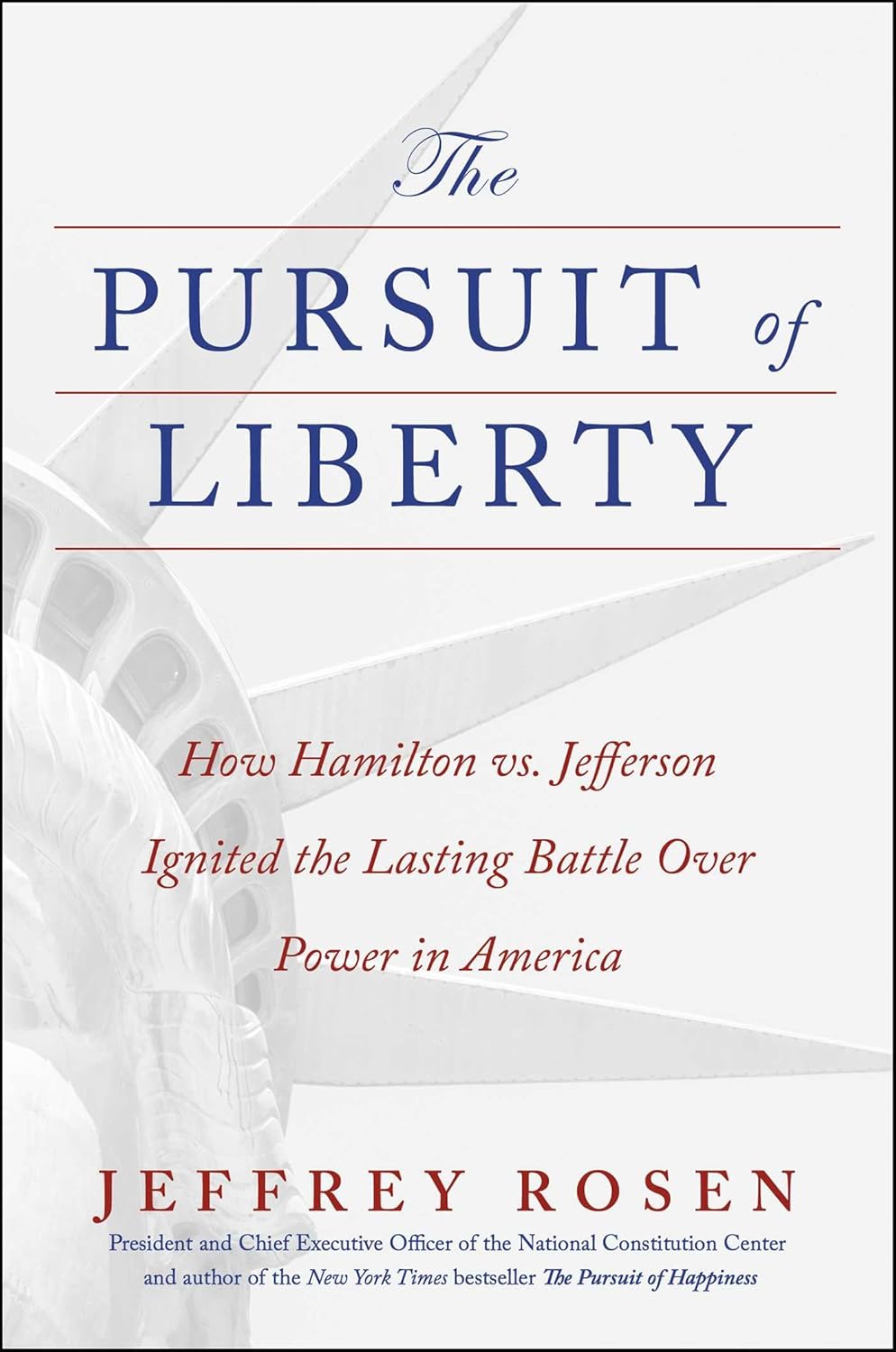
On the eve of the 250th anniversary of American independence, Jeffrey Rosen, president and CEO of the National Constitution Center, offers a fresh and timely perspective on the debate with the release of his new book, The Pursuit of Liberty: How Hamilton vs. Jefferson Ignited the Lasting Battle over Power in America, a linear narrative of the clashing ideas between the two Founders. Rosen masterfully reconstructs the story of the Hamilton-Jefferson debate on their own words and then traces references to them by politicians, presidents, and Supreme Court justices in American history.
Rosen admits the thesis that the Hamilton-Jefferson debate has been the essential debate in American political history is hardly new. Martin Van Buren first identified this debate in his Inquiry into the Origins and Course of Political Parties in the United States, which was published posthumously. The former president traced the origins of American political parties back to the initial Hamilton-Jefferson debate over the national bank. In the introduction to his twelve-volume edition of the papers of Alexander Hamilton, published in 1885, Henry Cabot Lodge wrote of the influence of Hamilton’s and Jefferson’s constitutional visions as being “[t]wo schools of political thought” whose “struggle for supremacy has made the history of our country.” In 1925, the journalist Claude Bowers published Jefferson and Hamilton: The Struggle for Democracy in America, in which Bowers downplayed the two Founders’ battle over states’ rights and national powers, and instead characterized the debate as a struggle between democracy and aristocracy. Bowers ultimately concluded that “all American history has since run along the lines marked out by the antagonism” between Hamilton and Jefferson.
Rosen follows the same historiographical strand of the Hamilton-Jefferson debate as its predecessors because, as he notes, the debate explains not only American political history, but also constitutional, intellectual, economic, and social history.
Rosen follows the same historiographical strand of the Hamilton-Jefferson debate as its predecessors because, as he notes, the debate explains not only American political history, but also constitutional, intellectual, economic, and social history. The Pursuit of Liberty begins with a dinner scene between Hamilton and Jefferson—not the famous one where the two men devised the compromise that allowed the creation of the national bank and assumption of state debt for a southern national capital—but rather another in which Jefferson noted Hamilton’s apparent praise of Julius Caesar. Hamilton’s remark, recorded by Jefferson, which Rosen labels as “the most significant conspiracy theory in American history,” accused Hamilton and the Federalists of an attempt to resurrect monarchy in the United States—a charge that has plagued the New Yorker to the present time.
Beyond the charge of monarchism, the constitutional disagreement over how to interpret the spirit of the Constitution sparked the battle over the national bank and has divided American political parties and its leaders ever since. For Hamilton and the Federalists, it was their belief that federal power should be construed liberally, whereas Jefferson and his Republican supporters sought strict construction of the powers enumerated by the Constitution. Politically, however, these opposing views were never static nor confined to a strict adherence of a political philosophy over time. Both Hamilton and Jefferson, at differing parts of their political life, abandoned their principles for partisan gain, and political parties followed suit. As Rosen emphasizes, during major turning points of American history—the Jacksonian era, the Civil War and Reconstruction, the New Deal, and the Reagan Revolution—presidents, both political parties, and the Supreme Court evolved for partisan gain, but along Hamiltonian and Jeffersonian lines.
One early example of this abandonment of constitutional principles for the political upper hand occurred during the Jefferson presidency over the issue of the acquisition of the Louisiana Territory. President Jefferson believed the only way to incorporate the territory was through a constitutional amendment. However, afraid that the deal with Napoleon might not hold as a possible amendment, Jefferson allowed Republicans to ratify the Louisiana Treaty. A congressional debate ensued where Democratic-Republicans of the Virginia school, who favored a strict interpretation of the Constitution and federal power, became defenders of implied powers under the Constitution. The Federalists, on the other hand, and particularly those in New England, suddenly transformed into supporters of strict constitutional construction and backers of states’ rights. The abandonment of constitutional moralities also occurred during the same time over executive power. President Jefferson, who was against military force to combat the Whiskey Rebellion, abruptly relished the opportunity to invoke the Insurrection Act to enforce his embargo.
Presidents, in general, sought to emulate the philosophies of Thomas Jefferson and Alexander Hamilton in relation to executive power. Rosen notes presidents like Abraham Lincoln and Franklin D. Roosevelt took a Hamiltonian approach and sought more governmental power and interpreted a more flexible construction of the Constitution; whereas presidents like Andrew Jackson and Ronald Reagan were more Jeffersonian and favored less governmental power based on an interpretation of strict construction of the Constitution. Then there was Theodore Roosevelt, who combined both Founders’ viewpoints, and looked towards “Hamiltonian means to achieve Jeffersonian ends.” Roosevelt’s New Nationalism approach advocated the use of a powerful federal government to regulate the economy with social and labor reforms. In particular, executive power suddenly became “the steward of the public welfare,” according to Roosevelt.
Rosen also weaves together the evolution of Hamiltonian and Jeffersonian constitutional interpretations that came from the Supreme Court. Relevant to the present argument over the role of originalism in court decisions, Rosen argues that historically the central dispute on the Supreme Court has not been between originalism and non-originalism, but rather between liberal and strict construction of federal power. In fact, Rosen states that neither Hamilton nor Jefferson, nor even the “Father of the Constitution” himself, James Madison, would be considered an “originalist” by the present Supreme Court’s standards. This framing by Rosen will undoubtedly raise pushback from some critics, but his main argument is that the Founders’ evolving opinions on constitutional issues, most notably in the debates over the national bank, place them more as living constitutionalists. In the national bank controversy, for instance, both Jefferson and Madison came to accept the bank’s constitutionality because for over twenty years it was legitimized by Congress, local authorities, and the American people.
What separates Rosen’s work from others is the fact that The Pursuit of Liberty does not attempt to select a winner in the Hamilton-Jefferson debate. Rather, it celebrates the clash between the two competing constitutional visions, which has made the continued success of the American experiment a reality.
What separates Rosen’s work from others is the fact that The Pursuit of Liberty does not attempt to select a winner in the Hamilton-Jefferson debate. Rather, it celebrates the clash between the two competing constitutional visions, which has made the continued success of the American experiment a reality. This success, however, is not because it requires agreement between Hamiltonians and Jeffersonians on how to balance liberty and power; rather, it requires a good faith commitment to the American Idea of liberty, equality, and the consent of the governed, by those who participate in the inevitable tug-of-war between the interpretations. Such is the ultimate sign of a healthy democratic republic.
For Rosen, the greatest threat to the American constitutional order dos not come from those who are “inconsistent in their devotion to the principles of Hamilton and Jefferson” but rather from those who have “rejected the principles entirely” and abandoned the entire premise of the American Idea. This threat goes beyond the many instances in American history where presidents are attacked by opponents who frame them as demagogues to score cheap political points. George Washington was considered the next “King George” by Anti-Federalists and Republicans, Andrew Jackson was named “King Andrew,” and Franklin D. Roosevelt was considered the incarnation of an American Caesar.
The rise of a popular demagogue is a constant theme in The Pursuit of Liberty. Dispersed throughout the pages are references to Julius Caesar and the prevalent threat demagoguery posed to the American Republic. For instance, Rosen notes FDR’s 1934 Caesar-themed birthday party in which the president dressed in a toga and laurel crown. The Founders were acutely aware of the threat, however. Hamilton believed that democracy could produce a demagogic Caesar from below, whereas Jefferson feared a rise of an American aristocratic Caesar that would come from the support of the upper echelon of society—the financial elite—who would in turn corrupt the virtue of the people. Hamilton believed that since the Constitution did not draw a distinction between social or economic classes, the danger of oligarchy did not exist. Jefferson and his political ally, Madison, were skeptical of this dismissal and hoped any oligarchs would be defeated in elections after the people were educated in what Jefferson referred to as “the habits of virtue.”
Yet, despite the awareness and warnings from both Hamilton and Jefferson, popular demagogues appeared at critical junctures in history and threatened the constitutional order. Three demagogue-like figures are highlighted in The Pursuit of Liberty: Aaron Burr, Henry Clay Warmoth, and Huey Long. All three were mired in corruption and attempted to subvert the Constitution to remain in power.
At the close of the eighteenth century, Aaron Burr, Thomas Jefferson’s vice president, served as the “prototype of demagogues who would recur throughout American history,” according to Rosen. Whether it was his secession conspiracy or subsequent treason trial, Burr might have been the subject of John Jay’s 1821 letter to John Adams where Jay stated he was “Certain of our Demagogues seem to regard Checks and Ballances [sic] as inconvenient obstacles.” Hamilton was certain of Burr’s populist authoritarian tendencies when he stated “[I]f we have an embryo-Caesar in the United States ‘tis Burr.”
In the post-Civil War era, Rosen focuses on Louisiana governor Henry Clay Warmoth, who championed internal improvements for the city of New Orleans. Warmoth consolidated personal control over the state’s militia, police forces, judges, and county clerks and created an election board to centralize the power to resolve disputed elections in his own hands. Corrupt and open to bribes, Warmoth was eventually impeached a month before his term ended for his alleged attempt to steal the election and use of the state’s militia to remain in power.
Not to be outdone, Rosen goes on to highlight another controversial Louisiana governor, Huey Long, as the poster child of a populist demagogue in the twentieth century. Long looked for ways to subvert the Constitution by consolidating the branches of government into his own hands. Calling special sessions of the state legislature and ordering the state supreme court to overrule decisions he disagreed with—Long’s dictatorial tendencies lead Rosen to quote historian David Kennedy’s conclusion that the governor made “Louisiana the closest thing to a dictatorship that America has ever known.”
Beyond these examples, Rosen notes the broader attempt to hijack the American Idea throughout history. From John Calhoun, who defended the institution of slavery as a “positive good” and called the principles of the Declaration of Independence a “self-evident lie,” to extremist ideologues today who want to tear down the Constitution and remake our system of government. These illiberal efforts in American politics go against the central tenets of the American Idea and Hamilton’s and Jefferson’s political philosophies.
Rosen concludes that “[t]he competing positions of Hamilton and Jefferson are like golden and silver threads woven throughout the tapestry of American history, sometimes side by side, sometimes crossing each other, and at critical moments, pulling far that they threaten to snap.” What has made the dispute between Hamiltonians and Jeffersonians about how to balance liberty and power a success (so far) is that these threads have not snapped. Although these two opposing constitutional visions have faced off against each other in every political debate, they have always been solidified in the principles of the American Idea: liberty, equality, and the consent of the governed—the principles that both Hamilton and Jefferson embraced themselves in their debates.
If Hamilton’s and Jefferson’s forebears continue to debate within the confines of those principles and participate with good faith commitment to the American Idea, the American experiment itself will remain successful for another 250 years. Thus, The Pursuit of Liberty is a necessary read for those who want to continue the legacies of two of the most important constitutionalists in American history.
Matt Riffe is the Executive Assistant to the President of the Jack Miller Center for Teaching America’s Founding Principles & History.