Puyallup, Washington: Home of the Generous People
JMC President Hans Zeiger reflects on the history of his hometown of Puyallup, Washington.
June 6, 2026
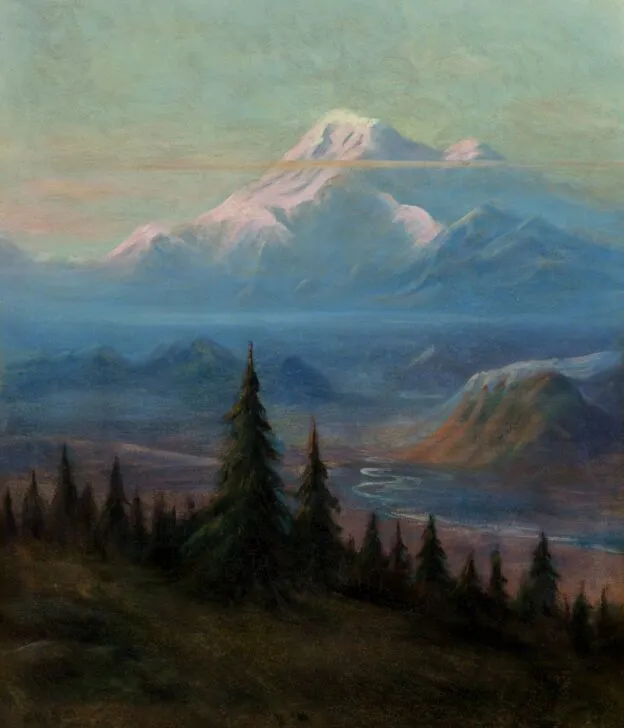
Puyallup is located in the lowlands of South Puget Sound, centered in a valley where the river carries snowmelt away from Mount Rainier and spills into Commencement Bay at Tacoma. You’re likely to pass through Puyallup if you’re heading to the glacier-bound volcano, and of all the many grand views of the peak the indigenous people called Tahoma, my favorites come from old photos showing it as the monumental backdrop for the acres and acres of daffodil fields that once spread across parts of the valley floor.
Though almost all of the bulb farms are gone now, the annual Daffodil Festival, with its Grand Floral Parade and pageant, comes back every April.
But Puyallup is best known as the home of the Washington State Fair. To the locals, the Fair will always be the Puyallup Fair, its official name until the Fair Board chose about a dozen years ago to embrace the marketing power of the “State Fair” designation. By then it was already one of the top 10 largest fairs in the country. To this day, late-summer TV ads in the Seattle region still feature a 1970s-era Fair jingle summoning all who hear to “Do the Puyallup.”
Puyallup is my hometown, but I didn’t fully appreciate it until I started studying its history in 2007, when I graduated college. After watching the miniseries Band of Brothers and Ken Burns’ documentary The War, I was overwhelmed with the realization that there was but a narrow window of opportunity to talk to members of the World War II generation. I decided to begin my own project of documenting Puyallup’s past.
Over the course of two years and 120 interviews, I listened to all kinds of memories of Puyallup. I heard about memories of cousins or classmates lost in battle; impressions of the Japanese-American internment camp that was set up in the fairgrounds between April and September of 1942 and what it meant; and stories of friends from Puyallup who reunited in theaters of war halfway across the world.
But the memory that stirred me the most came from an old airman named Jim Tresch, who had grown up on a dairy farm off Pioneer Way and then flew P40s and P47s over Europe.
But the memory that stirred me the most came from an old airman named Jim Tresch, who had grown up on a dairy farm off Pioneer Way and then flew P40s and P47s over Europe. He told me about his brother Al, who had been a troubled teen and a school dropout in the 1930s but who joined the Army and went on to survive the Fall of Corregidor and then the Bataan Death March and years in a POW camp.
After all that, he came home to the dairy farm in the fall of ’45. The first thing he wanted to do was to go up in an airplane over Puyallup. He had never been in an airplane, so the first order of business on coming home—against all the odds and after all the long, long days of starving and waiting—was to enlist his brother to fly him over his hometown. Jim and Al drove across town to a little airfield that used to run along the Puyallup River. Jim arranged to rent a plane for the afternoon, and in a few minutes the brothers were airborne, flying low over the town and buzzing the family farm. “Al was just having a great time,” Jim told me. When they landed, every police car in town was there to greet them. Jim talked his way out of trouble, and he carefully obeyed the speed limit on the way back to the farm.
I got to sit on the front porch of that house where Al and Jim grew up when I was doorbelling my way through Puyallup and surrounding areas as a candidate for a seat in the State House of Representatives in 2010. It was my season of doorbelling that further shaped my perspective on my hometown.
One day I knocked on the door of Conrad Thiede, just around the corner from my parents’ house in the neighborhood where I grew up. I had never had any reason to go talk to Conrad before. But after I knocked, he came out and sat on the porch and spent the next hour and a half explaining to me the history of the neighborhood. He had lived there since 1947. I learned about eccentric people who once lived in houses I’d walked by hundreds of times, a few tragedies of the past, and of families who had grown up together.
Every day, I would meet people who used to play sports with an uncle or attend church youth group with an aunt, or who took my great-grandfather’s science class. I reconnected with parents of high school classmates, heard deeply personal stories touching on a range of policy issues, and even met my dad’s high school football coach, Corky Diseth. At the end of the conversation, he said, “I’d vote for you, but I have a rule that I only write in my own name for every office.” I mentioned this to my dad shortly afterward. “That sounds like Corky,” he said.
When the votes were counted that November, I won the election by just 47 votes. That triggered an automatic hand recount, which I would go on to win by a mere 29 votes. After the recount, I received a list of all the write-in votes that were tabulated. And sure enough, there in the official vote count was the name Harry W. Diseth.
* * * *
My own Puyallup roots date to 1952, when my grandpa, Ed Zeiger, took his first job out of Central Washington University as the fifth grade teacher at Maplewood Elementary. Shortly after that, my great-grandparents Ernest and Leata Zeiger also settled in Puyallup and continued their teaching careers—Ernest as a junior high science teacher, Leata as the kindergarten teacher at Ezra Meeker Elementary. By 1979, my grandpa Ed was the principal at Wildwood Park Elementary School, and he hired Kim Nisker as the fourth grade teacher—and subsequently introduced his son Walt to Miss Nisker. Kim and Walt would get married in 1982, and I was born in 1985. This makes me the son, grandson, and great-grandson of Puyallup teachers.
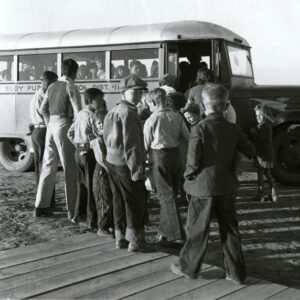
For reasons beyond my own family history and my own upbringing through the Puyallup schools, I believe that Puyallup is an education community at its core. Its teachers and coaches are revered, and it has produced more than its share of educational leadership for the state of Washington. Puyallup was home to Washington’s third governor, John R. Rogers, a member of the Populist Party whose greatest legacy was the Barefoot Schoolboy Act of 1895, which mandated the provision of basic education for every young person in the state. It was home to three different state superintendents, including Frank “Buster” Brouillet, who once narrowly defeated my grandfather to become president of the local teachers’ union, as well as Judith Billings and Randy Dorn, the latter of whom was in my great-grandmother’s kindergarten class. And Paul Hanawalt, who was superintendent of the Puyallup School District from 1930 until 1960, was not only a respected educational statesman but also a steward of community spirit whose impact remains discernible in Puyallup to this day.
Puyallup is a Coast Salish word that means something close to “The Generous People,” and it is the name of the tribe that originally inhabited the area and still maintains a powerful presence. Ezra Meeker, a legendary Oregon Trail pioneer, hop farmer, and renaissance man, took the tribal name and gave it to the town where he would become the first mayor in 1890. As he traveled across the country and abroad, though, Meeker had to reckon with one challenge: Few people knew how to pronounce Puyallup. In one of his several books, he described the predicament:
I accept the odium attached to inflicting that name on suffering succeeding generations by first platting a few blocks of land into village lots and recording them under the name Puyallup. … The first time I went East after the town was named and said to a friend in New York that our town was named Puyallup he seemed startled.
“Named WHAT?”
“Puyallup,” I said, emphasizing the word.
“That’s a jaw breaker,” came the response. “How do you spell it?”
“P-u-y-a-l-l-u-p,” I said.
“Let me see—how did you say you pronounced it?”
Pouting out my lips … and emphasizing every letter and syllable so as to bring out the Peww for Puy, and the strong emphasis on the al, and cracking my lips together to cut off the lup, I finally drilled my friend so he could pronounce the word, yet fell short of the elegance of the scientific pronunciation.
Meeker went on at some length describing anecdotes of mispronunciations and awkward introductions, concluding, “But when letters began to come addressed ‘Pewlupe,’ ‘Polly-pup,’ ‘Pull-all-up,’ ‘Pewl-a-loop,’ and finally ‘Pay-all-up,’ then my cup of sorrow was full.” The chronicles of failed attempts to say Puyallup have continued, such as when broadcasters butchered the name during the 2000 Olympic Games as Puyallup’s own Megan Quann won two gold medals in swimming.
Puyallup may be hard to pronounce, but I do think it has a fine record of living up to the meaning of its name, the Generous People.
I once witnessed the combination of tradition and generosity at Puyallup High School’s Alumni Assembly, a big annual gathering of current and graduated classes just before Christmas. Several years ago, student body officers called on their fellow students to make wishes, and there in that packed gym the student leaders went around granting the wishes. There were hugs, gifts of candy, and more. The class arranged for the adoption of a cat from the Humane Society for a girl whose cat had died. The baseball team awarded a plaque to a boy for his dedication to their team as the student manager. It was a moving thing to watch.
Puyallup’s generosity is evident in several independent local charities that have taught me much about how private organizations can tap into the energies, talents, and goodwill of faithful volunteers, church congregations, and loyal donors to make a profound difference for people. Puyallup’s service clubs and veterans groups also add much to the voluntary spirit of the community. “Generous People” is a fitting title.
* * * *
While agriculture is not what it once was in the Puyallup Valley, good things are still growing from that fertile soil. And agriculture itself still holds on in a few places. The Richter family is doing their part for the rhubarb market. Back when Tim Richter, Jr. and I were in elementary school together, I got to ride the fields in Tim Sr.’s big tractor. Now Tim Jr. is helping to keep the family farm alive in a new generation.
Berry farming was once a very big deal in the valley, and many a Puyallup kid had their first job harvesting berries in the summertime. Not far from the Richters, the Picha family is carrying on their multigenerational strawberry and raspberry farm, and you can buy fresh berries from their roadside stand in the summer months. And on Saturdays in season, you can still buy your fill of local produce at the Puyallup Farmers Market.
Communities grow and change. But with some commitment and affection, they can keep their roots.
Several blocks east of the house where I grew up is where my great grandparents lived for decades. In the late 1980s, my great-grandpa Ernest Zeiger and a few neighbors lobbied the city council to save a giant black walnut tree next to one of the neighborhood’s main roads from being torn down. It was a big tree to maintain, and it dropped loads of nuts into the street. But to the neighbors, the tree was special. They called it the “Centennial Tree,” since it had been planted in 1889, the year Washington achieved statehood. And to my great grandfather, a tree like that was a source of beauty and grandeur in the neighborhood.
Well, that great old black walnut still stands there today as a testimony to the dedication of those neighbors, a sidewalk winding its way around the trunk, and the branches reaching out over the road. Every time I see it, it reminds me of the meaning of the place where I’m from, this home of the Generous People.
Hans Zeiger is president of the Jack Miller Center for Teaching America’s Founding Principles & History.